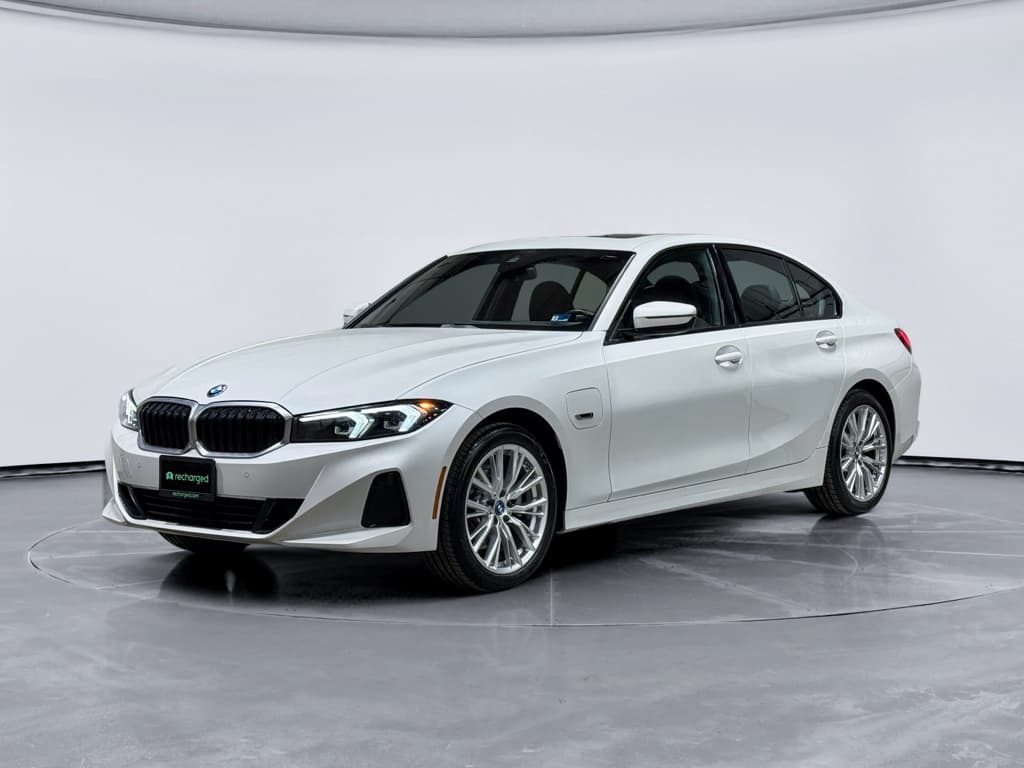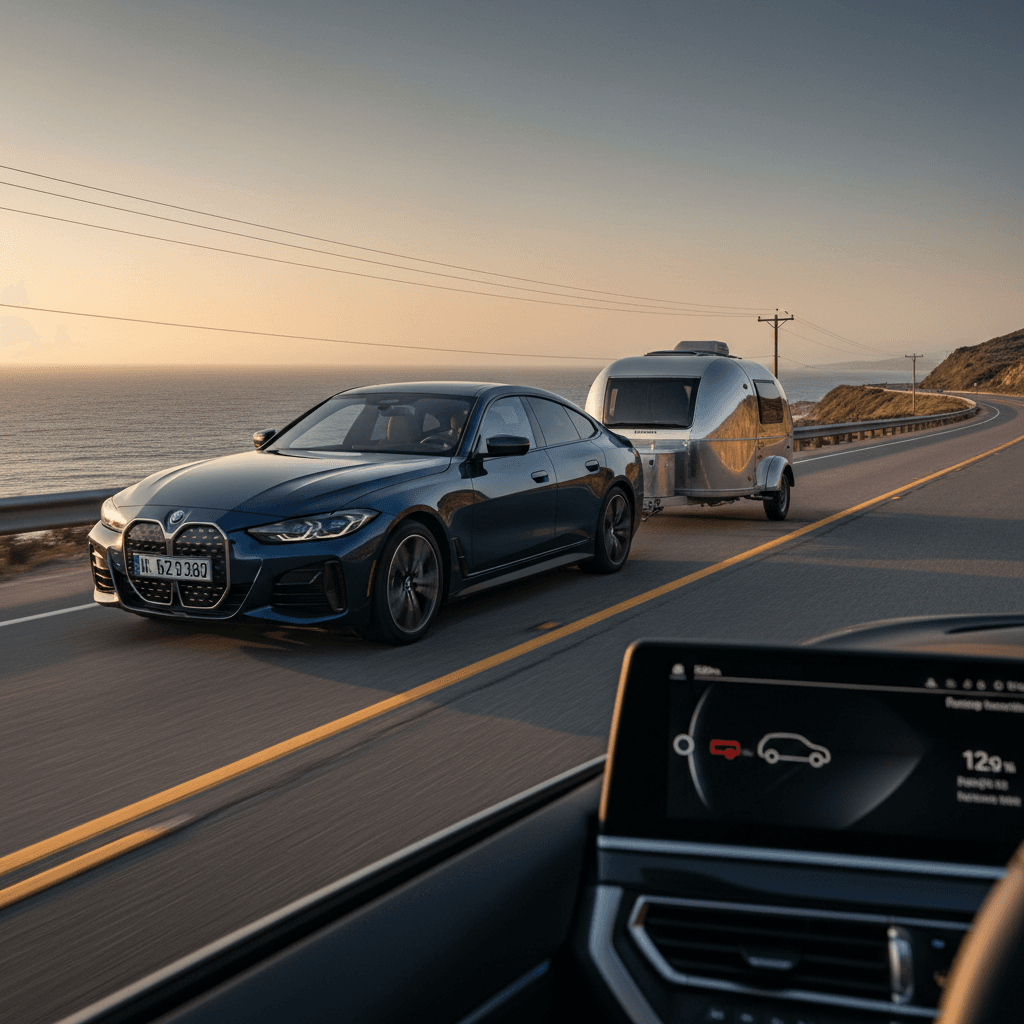
If you’re looking at a BMW i4 and wondering whether it can handle a small trailer or bike rack, and what that does to range, you’re asking exactly the right questions. The BMW i4’s towing capacity and range loss aren’t obvious from U.S. marketing materials, but they matter a lot if you’re planning road trips, moving gear, or hauling bikes.
Quick answer
Can the BMW i4 actually tow?
BMW does engineer the i4 for towing. In European documentation and launch material, the car is rated for a maximum braked towing capacity around 1,600 kg (≈3,500 lb), with a tongue weight in the 75 kg (≈165 lb) range when equipped with the factory towbar. That’s broadly in line with aftermarket hitch ratings you’ll see from companies like EcoHitch and Stealth Hitch, which typically quote 3,500 lb towing / 350 lb tongue for the i4 chassis.
In North America, BMW has been more conservative in how it markets towing for the i4. You’ll often find U.S. spec sheets that are silent on towing, and many dealers will simply say “BMW doesn’t recommend towing with the i4.” That’s more about liability and fitting hitches to a relatively low‑volume model than a fundamental engineering limitation of the platform.
Region matters
BMW i4 towing capacity by model & equipment
Typical BMW i4 towing ratings (factory towbar)
Approximate manufacturer and third‑party figures for the main BMW i4 variants. Always verify against your specific car’s documentation.
| BMW i4 variant | Drivetrain | Max braked towing | Max unbraked towing | Max tongue weight | Roof load |
|---|---|---|---|---|---|
| i4 eDrive35 / eDrive40 | RWD | ≈1,600 kg (≈3,500 lb) | ≈750 kg (≈1,650 lb) | ≈75 kg (≈165 lb) | ≈75 kg (≈165 lb) |
| i4 xDrive40 / M50 | AWD | ≈1,600 kg (≈3,500 lb) | ≈750 kg (≈1,650 lb) | ≈75 kg (≈165 lb) | ≈75 kg (≈165 lb) |
| Aftermarket hitches (EcoHitch, Stealth, etc.) | Any i4 | 3,500 lb (vendor rating) | Not always specified | 350 lb (vendor rating) | N/A |
These figures are indicative, not a substitute for your owner’s manual.
Respect the lowest number
BMW i4 towing & load numbers at a glance
How much range do you lose when towing with a BMW i4?
The BMW i4 is relatively efficient for its size, many owners see 3.0–3.7 mi/kWh in gentle driving, which is how you get EPA‑style ranges in the 250–300+ mile ballpark depending on trim. Towing changes that picture dramatically, not because the drivetrain is unhappy, but because aerodynamic drag and rolling resistance skyrocket with a trailer hanging off the back.
In a well‑publicized UK tow‑car test, a BMW i4 pulling a full‑size caravan loaded to roughly 85% of the car’s curb weight managed about 113 miles on a charge, roughly half the solo‑driving range you’d expect at similar speeds. That’s a useful benchmark: for big, blunt campers, assume 40–55% range loss at highway speeds.
Typical BMW i4 range loss by what you’re carrying
These are ballpark figures, assuming highway speeds and mild weather.
Rear‑hitch bike rack (2–4 bikes)
Expected range loss: 5–20%
2 lightweight bikes on an aerodynamic rack might only cost you ~5–10%. Four mountain bikes on a platform rack stick well into the airflow and can hit 15–20%, especially above 70 mph.
Small cargo trailer (utility or moto)
Expected range loss: 20–40%
A low, narrow trailer that mostly hides in the i4’s wake is much easier on range than a tall box. Weight matters on hills; shape matters everywhere.
Full‑height camper or caravan
Expected range loss: 40–55%+
This is where range can effectively be cut in half. Plan much shorter legs between fast chargers and keep highway speeds conservative.
Speed is your biggest lever
Real‑world BMW i4 towing scenarios
1. Occasional DIY runs with a small utility trailer
If you’re thinking about a 4x8 utility trailer for dump runs, yard projects, or the occasional IKEA haul, the i4 is actually well‑suited, as long as you respect weight limits.
- Trailer weight: often 500–900 lb empty
- Typical load: another 300–800 lb
- Total trailer & load: usually under 2,000 lb
At those weights, the drivetrain barely notices the mass; it’s the frontal area that costs you. With a low, open trailer, you might see 20–30% range loss at highway speeds and less around town.
2. Regular family trips with a full‑size camper
If you picture the i4 as a replacement for a diesel wagon or SUV that tows a tall caravan every other weekend, you’ll need to re‑calibrate expectations.
- Trailer weight: often 2,500–3,500 lb
- Frontal area: much larger than the car
- Range loss: commonly 40–55% at 60–70 mph
Instead of 250+ mile legs, think 90–130 miles between fast charges, with more time spent charging because you’re arriving at each stop with a lower state of charge.
The i4’s battery, roughly 70–84 kWh usable depending on variant, has the grunt to tow without overheating or feeling unstable. Where things get tricky is simply the math of watt‑hours per mile. Double consumption by hanging a big camper off the back, and you halve your usable range.
Hitches, bike racks, and warranty considerations
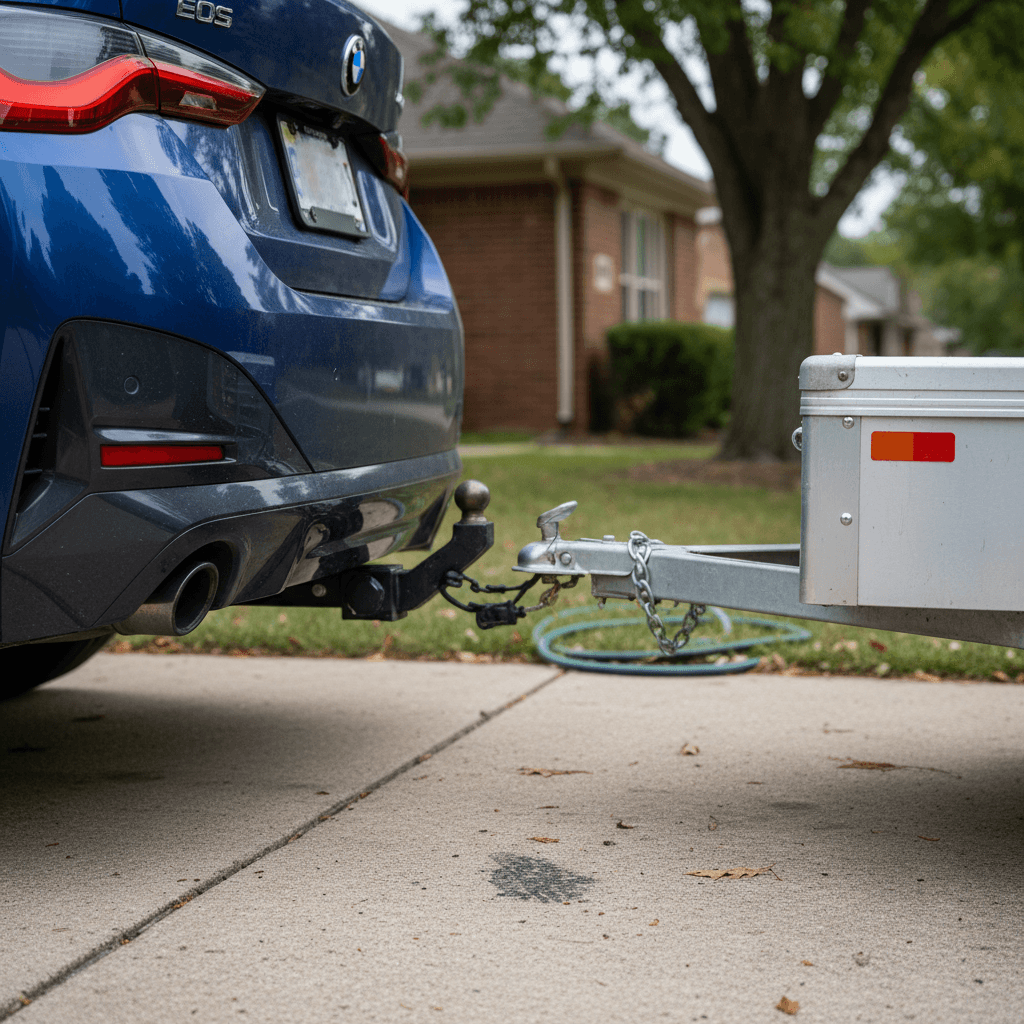
For many i4 owners, the goal isn’t towing a camper; it’s carrying bikes or a small cargo platform. That’s usually easier, safer, and less punishing on range than full‑on towing, but you still need to think about hardware and ratings carefully.
- In Europe and some other markets, BMW sells a factory towbar with integrated wiring and a documented 1,600 kg towing limit.
- In the U.S., owners typically rely on aftermarket hitches (EcoHitch, Stealth Hitch, etc.) rated around 3,500 lb / 350 lb tongue, commonly used for bike racks rather than heavy towing.
- Many i4 owners use 2‑ or 4‑bike hitch racks without issue, but total rack + bike weight must stay under the hitch and tongue weight ratings.
- Some insurers and dealers may frown on towing with a vehicle not officially marketed for towing in your region, even if the hardware and platform are capable.
Warranty & liability reality check
Checklist: choosing a hitch for your BMW i4
1. Confirm your use case
Are you mainly carrying bikes, or do you truly plan to tow a trailer? A rack‑only setup can be lighter and simpler than a full towbar with wiring harness.
2. Compare hitch ratings
Look for clear specs: <strong>maximum trailer weight and tongue weight</strong>. Both numbers must comfortably exceed what you plan to tow or carry.
3. Check installation method
Some hitches are bolt‑on and reversible; others require trimming undertrays. Professional installation is strongly recommended on a high‑value EV like the i4.
4. Consider wiring needs
For real trailers with lights and brakes, you’ll need a wiring solution integrated into the car’s systems. That’s more involved than a rack‑only hitch used just for bikes.
5. Ask about sensor & diffuser impact
Make sure the hitch won’t permanently block rear parking sensors or prevent re‑installing the lower bumper diffuser, unless you’re fine with the cosmetic tradeoff.
Planning trips: accounting for BMW i4 range loss when towing
Once you accept that towing dents range, the next step is planning around it. The good news: the i4’s fast‑charging capability and strong efficiency when driven sensibly give you room to work with, especially if you’re thoughtful about how far you go between stops.
Practical planning rules when towing with an i4
Use these as conservative baselines, then refine with your own data.
Cut the brochure range in half
If your trim is rated for 270 miles, assume 130 miles usable when towing a big trailer. For light trailers or just bikes, you might live closer to 70–80% of normal range.
Plan shorter legs between fast chargers
On road trips, aim for 60–90 mile hops between DC fast chargers when towing, especially in cold weather or hilly terrain.
Mind temperature & elevation
Cold batteries, strong headwinds, and long climbs can stack on top of towing losses. Give yourself a margin rather than driving to 0%.
Use live consumption as your guide
Is the BMW i4 right for you if you tow regularly?
Whether the BMW i4 makes sense for you comes down to how often and what you tow. As a daily driver that occasionally pulls a light trailer or carries bikes, it’s a compelling package: refined, efficient, and more than strong enough for modest loads. As a primary tow rig for a big camper, it requires more compromise and planning than many people expect.
Great fit
- You mostly tow a small utility or motorcycle trailer a few times a year.
- You want a hitch primarily for bike racks or a cargo platform.
- Your typical towing trips are under 100 miles one‑way, with easy access to home or public charging.
- You value the i4’s refinement and performance more than maximum road‑trip flexibility with a camper.
Think twice
- You tow a tall, heavy caravan frequently and expect 200+ mile stints between stops.
- You need to tow near the 3,000–3,500 lb limit in steep or remote terrain.
- You live somewhere with limited DC fast charging along your typical towing routes.
- You’re not interested in slowing down; you habitually cruise well above the speed limit even when towing.
How Recharged can help you decide
Ready to find your next EV?
Browse VehiclesFAQ: BMW i4 towing capacity and range loss
Frequently asked questions
The BMW i4 can tow more than its low‑slung, coupe‑like shape suggests, but physics still wins. A 3,500 lb rating on paper doesn’t mean 300 miles of highway range with a brick‑shaped camper; it means you have the structural headroom to do the job if you plan around the energy cost. If your needs are bike racks, the occasional utility trailer, or modest loads on relatively short trips, the i4 is a capable and enjoyable EV that can pull its weight, literally. If you’re counting on long, fast towing days with a big trailer, you’ll either need to embrace shorter legs and slower speeds or look at an EV designed expressly with heavy towing in mind.