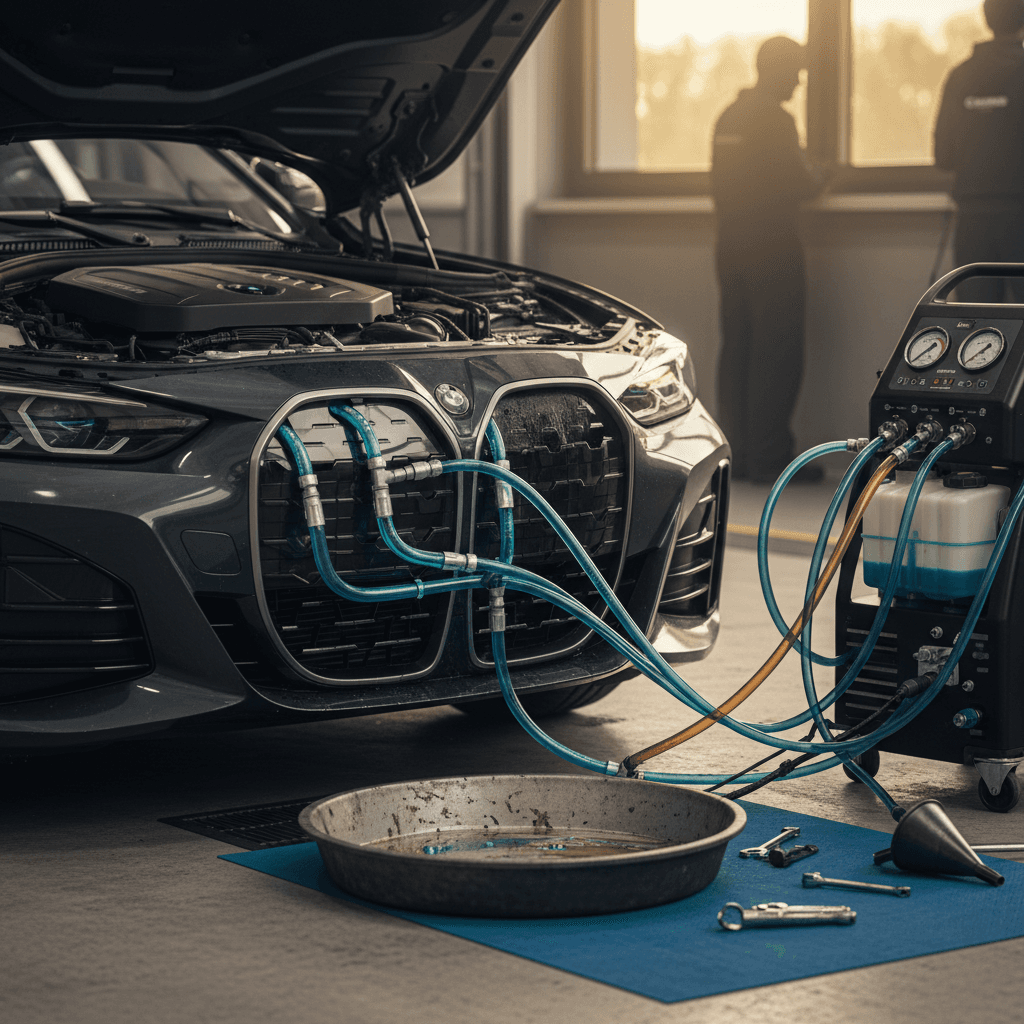
If you own or are shopping for a BMW i4, you’ll eventually run into service advisors talking about a coolant flush or battery coolant change. With a high‑voltage battery and multiple cooling loops under the floor, it’s fair to ask: what does a BMW i4 coolant flush cost, how often do you really need it, and are dealers overselling the service?
Quick answer
BMW i4 coolant flush cost overview
Typical BMW i4 coolant service numbers (2025)
Unlike an internal‑combustion BMW where you may see aggressive “every year” coolant pitches, the i4’s factory documents and realistic maintenance schedules point toward long‑life coolant with service only every several years, or when the system is opened for other repairs. Some dealer service departments, however, still treat every BMW like a gas 3 Series and will call you in far more often than necessary.
Watch for upsells
How the BMW i4 cooling system works
Multiple coolant loops, one purpose
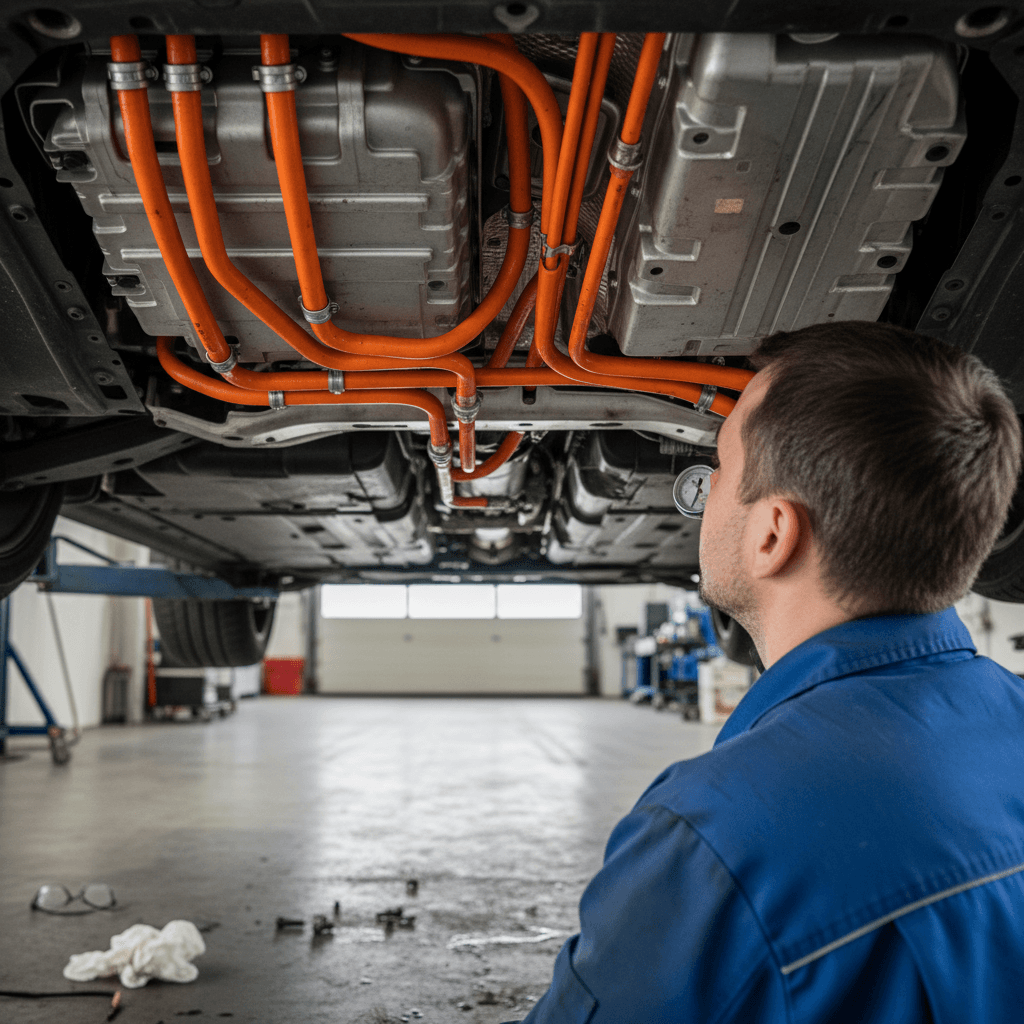
The BMW i4 doesn’t have an engine, but it does have a complex thermal management system that keeps the high‑voltage battery, power electronics, and sometimes the cabin comfortable and safe. It typically includes:
- A dedicated battery coolant loop running through the pack and underbody lines.
- A loop for the drive unit and power electronics.
- Integration with the HVAC system for heating and cooling, especially during DC fast charging.
Why coolant matters on an EV
On the i4, coolant isn’t about keeping pistons cool, it’s about protecting a five‑figure battery pack and inverters. The right coolant and correct fill procedure help:
- Prevent overheating during fast charging or hard driving.
- Maintain even temperatures across the battery, which supports long‑term battery health.
- Avoid corrosion and deposits in small passages and heat exchangers.
That’s why BMW uses specific, long‑life coolant formulations and prescribes careful bleeding or vacuum‑fill procedures instead of a simple driveway drain‑and‑fill.
When does a BMW i4 actually need a coolant flush?
Official language in BMW EV warranty and service documents tends to talk about coolant checks more than frequent flushes. Some third‑party guides mention intervals like 4 years or 50,000 miles, but in real‑world ownership, most i4s won’t see a dedicated coolant change until later, often closer to the first major service at 60,000 miles or beyond, or when a component is replaced.
- Routine interval: Expect a coolant service recommendation roughly every 4–6 years or 60,000–100,000 miles, depending on climate and usage.
- When parts are replaced: Any repair that opens the cooling circuit (such as a leaking valve, pump, or radiator) will require partial or full coolant replacement.
- Contamination or wrong fluid: If non‑approved coolant or tap water has been added, a flush becomes more urgent.
- Warning messages: iDrive alerts about cooling system faults, overheating, or reduced power can trigger a diagnostic visit that ends with new coolant as part of the repair.
Check the digital service schedule
BMW i4 coolant flush cost breakdown
BMW i4 coolant service: typical U.S. cost ranges
Realistic price bands for BMW i4 coolant replacement in 2025, assuming out‑of‑warranty service.
| Service scenario | Where it’s done | What’s included | Typical cost |
|---|---|---|---|
| Basic battery/electronics coolant drain & fill | Independent EV shop | Drain one main loop, refill with BMW‑approved coolant, bleed system | $250–$350 |
| Comprehensive coolant service (multiple loops) | BMW dealer | Drain and refill multiple loops, vacuum‑fill, full system check | $350–$500 |
| Coolant top‑off & inspection | Dealer or independent | Visual inspection and minor top‑off if low, no major labor | $0–$75 |
| Coolant change bundled with repair | Dealer or independent | Coolant replacement as part of fixing a leak, valve, or pump | Adds ~$75–$150 in parts plus labor already billed for the repair |
Actual pricing varies by region, shop labor rate, and how much of the cooling system is serviced at once.
Those numbers line up with what we see across modern BMWs: straightforward coolant services often fall in the $300–$400 range, with complex jobs or high‑labor markets stretching closer to $500. The i4’s added complexity is more about procedures and safety than dramatically higher parts cost, the coolant itself is not exotic.
Good news for EV owners
Dealer vs. independent shop for i4 coolant service
Where to get your BMW i4 coolant flushed
The right shop matters more than simply "dealer" or "independent."
BMW dealership
Pros
- Factory training on high‑voltage cooling systems.
- Access to BMW diagnostic software and technical bulletins.
- Easy warranty documentation if repairs are needed later.
Cons
- Hourly labor rates are usually the highest in town.
- More aggressive upselling of extra services you may not need.
Independent EV specialist
Pros
- Labor rates typically 10–30% lower than dealer.
- Many shops now have EV‑trained techs and safety equipment.
- More flexibility to service outside rigid factory menus.
Cons
- You must verify they’re certified for high‑voltage work.
- Some may still be learning BMW‑specific procedures.
On a high‑voltage EV like the i4, the shop’s comfort level with orange‑cable work, isolation testing, and BMW’s bleeding procedures is far more important than squeezing out the last $20 of savings. If your local independent shop mainly does oil changes and brake pads, coolant on an i4 might be out of their comfort zone.
High‑voltage safety isn’t optional
Signs your BMW i4 may have a coolant issue
Most BMW i4s will quietly log thousands of miles with no coolant drama. But when something does go wrong, a leaking changeover valve, a loose clamp, or a sensor fault, it’s better to catch it early. Here’s what to watch for.
- iDrive warnings or reduced power: Messages about drivetrain performance, cooling system faults, or reduced output when fast charging should be investigated right away.
- Visible coolant under the car: Puddles or stains under the parking area near the front or middle of the car deserve a closer look.
- Repeated cooling fans or pump noise: Cooling components that run unusually often, even at modest temperatures, can signal a control issue.
- Overheating or charging limits: If DC fast‑charge sessions slow down dramatically or are cut short due to temperature, a coolant issue may be part of the story.
Don’t ignore small leaks
Coolant flush and BMW i4 warranty: what to know
BMW’s high‑voltage battery warranty in the U.S. generally runs for eight years or 100,000 miles (check your model year booklet for exact terms). That warranty assumes the cooling system is maintained according to BMW’s own service schedule, not whatever interval a third‑party shop invents.
- Follow documented intervals: If BMW specifies a cooling‑system check or fluid replacement at a certain year/mileage, keep records that you complied, at the dealer or at a qualified independent shop using BMW‑approved coolant.
- Use correct coolant: Mixing generic or incorrect coolant can give BMW an excuse to push back on related warranty claims. Always specify BMW‑approved EV coolant.
- Keep invoices: Document who did the work, what fluid was used, and the mileage/date. That protects you for both warranty discussions and future resale.
- Unnecessary early flushes: Doing a flush earlier than BMW calls for won’t void your warranty, but it also doesn’t win you any points. It simply costs you money sooner.
What about BMW prepaid maintenance?
How coolant service affects used BMW i4 buyers
If you’re not just maintaining an i4 but shopping for a used one, coolant history is one of those line items that rarely makes the sales listing, but it can tell you how the car was treated and whether there have been underlying issues.
What to look for in service records
- Factory‑aligned timing: Coolant checks or changes near 4–6 years/60,000+ miles make sense. Multiple flushes early in life can hint at recurring issues.
- Leak repairs: Receipts mentioning valves, pumps, or cooling modules are not automatic deal‑breakers, but they’re worth a closer look.
- Correct fluid: Service lines that call out BMW‑approved coolant, not generic green fluid, suggest the previous owner didn’t cut corners.
How Recharged helps used‑i4 shoppers
Every used EV sold through Recharged includes a Recharged Score Report that digs deeper than basic maintenance stamps. For a BMW i4, that means:
- Reviewing thermal management faults and alerts recorded by the car.
- Checking for signs of overheating, derating, or chronic fast‑charging issues.
- Verifying that any cooling‑system repairs were completed properly before the car is listed.
That way you’re not buying an i4 that looks fine on paper but has been quietly fighting coolant issues for years.
Practical BMW i4 coolant flush checklist
Before you approve a BMW i4 coolant flush
1. Confirm it’s actually due
Check your i4’s <strong>iDrive service menu</strong> and owner’s manual for any coolant‑service callouts. If nothing is listed as due, ask the advisor to show where they’re getting their interval.
2. Ask which loop they’re servicing
Your i4 may have multiple coolant loops. Clarify whether the shop is draining just the battery loop, the electronics loop, or the whole system, and how that affects price.
3. Verify BMW‑approved coolant
Insist on BMW‑approved coolant mixed to the correct ratio with distilled or de‑ionized water. This matters for corrosion resistance and compatibility with EV components.
4. Confirm EV safety credentials
Make sure the technician doing the job is <strong>qualified for high‑voltage work</strong>. Ask how they de‑energize or isolate components while the system is open.
5. Get a written estimate
Ask for a line‑item estimate that separates labor, coolant, and any additional parts. For a routine job, expect labor in the 1.5–3.0 hour range.
6. Keep all documentation
Save invoices and service reports. These protect you for <strong>warranty discussions</strong> and help boost resale value if you later sell or trade the i4, especially through a marketplace like Recharged.
BMW i4 coolant flush FAQ
Frequently asked questions about BMW i4 coolant flush cost
Bottom line on BMW i4 coolant flush costs
A BMW i4 coolant flush isn’t a frequent line item, but when it does appear on the estimate sheet, you’re generally looking at $250–$500 depending on where you go and how much of the system is serviced. The bigger story isn’t the price, it’s timing and trust. Follow BMW’s actual schedule, not generic postcards; choose a shop that understands EV cooling and high‑voltage safety; and keep documentation so your battery warranty and resale value stay intact.
If you’re pricing out a used BMW i4, coolant history and thermal behavior are one piece of the larger cost‑to‑own puzzle. That’s exactly what Recharged is built to simplify: every car we sell comes with a Recharged Score Report, EV‑specialist guidance, and a transparent view into battery health and maintenance history, so a line item like “coolant flush” is just another well‑planned expense, not an unpleasant surprise.