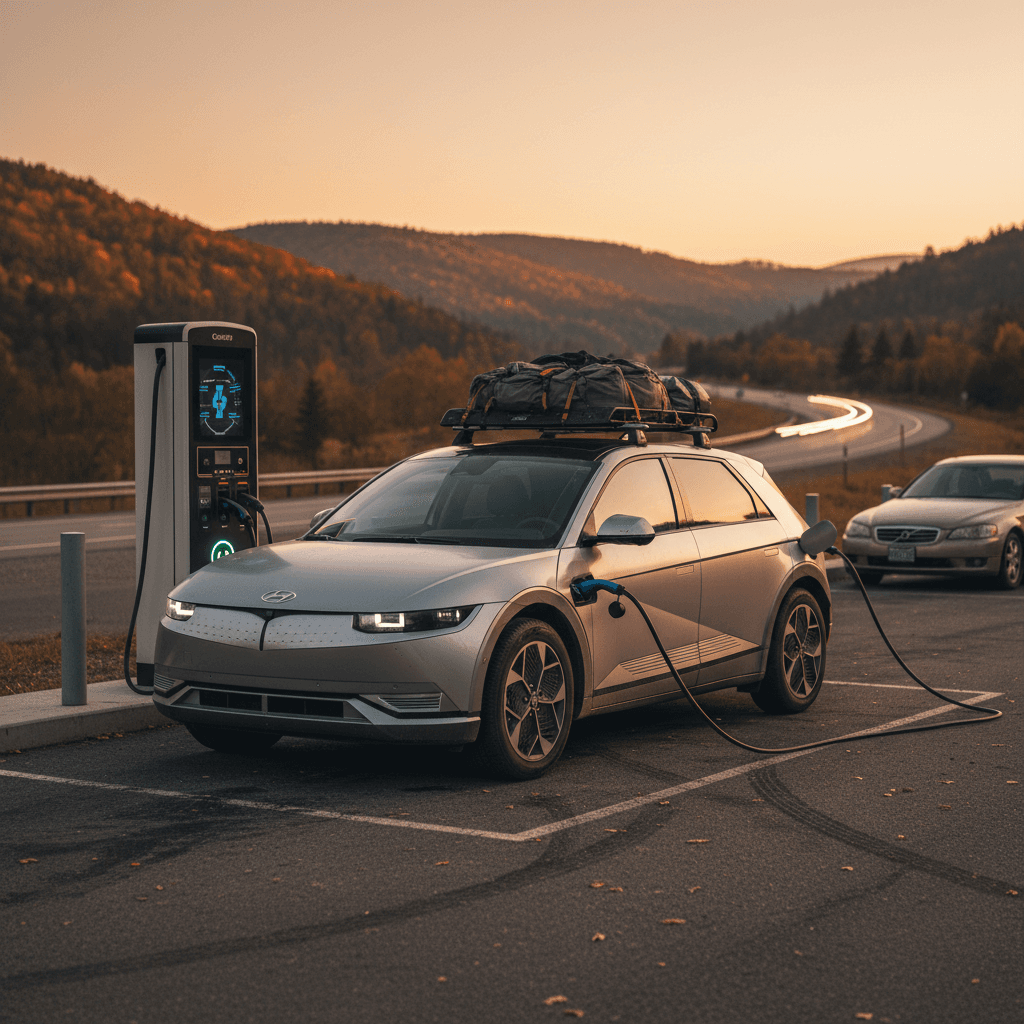
If you road‑trip or rely on public infrastructure, the **best used electric car for fast charging** can matter just as much as price, range, or styling. The right used EV can add 150–200 miles of range in under 20 minutes; the wrong one might leave you nursing a slow charger at every stop. This guide breaks down which used EVs are genuinely quick on a DC fast charger, what those numbers mean in the real world, and how to shop smart so you don’t overpay for speed you’ll never use.
Fast vs. "fast enough"
Why fast charging matters for used EV buyers
Where fast charging makes the biggest difference
If these sound like you, prioritize DC fast‑charge performance when you buy used.
Regular road‑trippers
Apartment and condo drivers
Busy families & fleets
If you mostly charge overnight at home and only road‑trip a couple of times a year, you may not need the absolute fastest‑charging models. But when you’re shopping the used market, **charging speed often tracks with newer tech**, 800‑volt architectures, better heat management, and stronger software support. Those improvements can pay off in both convenience and long‑term value.
How DC fast charging really works
When you plug into a DC fast charger, you’re bypassing the car’s onboard AC charger and feeding DC power straight into the battery. The **headline number, 150 kW, 250 kW, 350 kW, describes peak power**, not the average rate over the whole session. What actually matters is how long the car can hold a high rate between roughly 10% and 60–70% state of charge before tapering down.
- Most used EVs today peak between **100–270 kW** on DC fast charging.
- Cars with **800‑volt systems** (like Porsche Taycan, Hyundai Ioniq 5/6, Kia EV6) can use 350 kW chargers more effectively than 400‑volt cars.
- The common benchmark is **10–80% charge time**; for today’s quickest EVs, that’s as low as 18–24 minutes in ideal conditions.
- Cold batteries, shared chargers, and high states of charge can all **slow things down considerably**.
Cold batteries charge slower
Fastest-charging used EVs: the shortlist
New‑car lists of the "fastest‑charging EVs" tend to feature six‑figure exotics and models that are still scarce in the used market. For shoppers browsing 2‑ to 5‑year‑old vehicles in 2025, these are the **standout used EVs for fast DC charging** that you can actually find on dealer and marketplace lots.
Top fast‑charging used EVs worth targeting
Headline numbers are manufacturer or independent test figures for ideal conditions on high‑power DC fast chargers.
Hyundai Ioniq 5 (2022–2024)
Hyundai Ioniq 6 (2023–2024)
Kia EV6 (2022–2024)
Porsche Taycan (2020–2023)
Tesla Model 3 & Model Y (2019–2023)
GMC Hummer EV, Kia EV9 and others
Think in minutes, not just kW
Fast-charging used EV comparison table
Headline fast‑charging specs for common used EVs
Approximate manufacturer or independent‑test numbers for popular used models in ideal conditions. Real‑world speeds vary with charger, battery temperature, and state of charge.
| Model (used) | Battery architecture | Peak DC rate (kW) | Approx. 10–80% time | Connector when new |
|---|---|---|---|---|
| Hyundai Ioniq 5 (22–24) | 800 V | ~235 | ~18 min | CCS1 |
| Hyundai Ioniq 6 (23–24) | 800 V | ~235 | ~18 min | CCS1 |
| Kia EV6 (22–24) | 800 V | ~235 | ~18 min | CCS1 |
| Porsche Taycan (20–23) | 800 V | 270–320 | ~18–22 min | CCS1 |
| Tesla Model 3 / Y (19–23) | 400 V | up to ~250 | ~25–30 min | Tesla (NACS) |
| Chevrolet Bolt EV/EUV (17–23) | 400 V | ~55 | ~35–45 min (to 80%) | CCS1 |
| Nissan Leaf (40–62 kWh) | 400 V | ~50–100* | ~40–60 min (to 80%) | CHAdeMO |
| VW ID.4 (21–23) | 400 V | ~125–175 | ~30–36 min | CCS1 |
Use this as a directional guide, not a promise of what you’ll see on every charger.
About those asterisks
Real-world vs. spec-sheet charging speeds
Manufacturers quote best‑case numbers: warm battery, low starting state of charge, a high‑power charger that’s not shared, and firmware tuned for aggressive charging. In the used world, you’re layering in **battery aging, past charging habits, and software updates** that may have tweaked the charging curve.
What the brochure says
- "10–80% in 18 minutes" on a 350 kW charger.
- Peak power of **250–320 kW** for a short window.
- Charging stops modeled in ideal weather at highway speeds.
- Brand‑new battery with perfect thermal management.
What you may see used
- Colder weather or a half‑warm pack stretching that same window to **25–35 minutes**.
- Charger limited to **150 kW** despite a 350 kW label, due to site constraints or load‑sharing.
- Battery wear and software updates softening the charging curve a bit to protect longevity.
- Occasional stalls or session restarts, especially at older or poorly maintained sites.
Look for independent charging tests
Battery health and fast charging on used EVs
Charging speed and battery health are joined at the hip. A degraded or mistreated pack can **charge more slowly and hold less energy**, even if the car started life as a fast‑charging champion. That’s why evaluating battery condition should be non‑negotiable when you’re paying extra for fast‑charge capability.
How fast charging and battery health intersect
What to pay attention to when you’re looking at a specific used EV.
State of health (SOH)
Charging curve shape
Thermal history
Where Recharged fits in
What to look for when you shop a fast-charging used EV
Fast‑charging used EV buying checklist
1. Verify the connector and network fit your life
In North America, prioritize **CCS1 or NACS** ports over CHAdeMO. Think about where you actually drive, if there’s a dense Tesla Supercharger presence along your routes and your EV has or can use NACS, that’s a big plus.
2. Ask for battery health documentation
Look for **third‑party or OEM diagnostics** showing battery state of health. A seller that can’t or won’t share basic SOH information on a premium fast‑charging EV is a red flag.
3. Test a fast-charge session before you buy
If possible, plug the car into a local DC fast charger from a low state of charge and watch **how quickly it ramps up and how long it holds high power**. A car that lingers under 60–70 kW despite higher specs may have issues.
4. Check software and recalls
Many EVs have had **firmware updates that tweak charging behavior**, add preconditioning, or improve thermal control. Make sure the car is current on updates and any charging‑related recalls or service campaigns.
5. Inspect charging port and cables
On older used EVs, look for **worn or damaged pins, misaligned doors, or previous repairs** around the charge port area. Replacements can be expensive and may affect reliability at high power.
6. Balance speed with overall value
Paying a premium for flagship fast charging doesn’t always pencil out if you only fast‑charge a few times a year. Sometimes a **slightly slower, much cheaper used EV** paired with good home charging is the smarter move.
Charging networks, connectors, and adapters
Charging speed on paper doesn’t help much if you can’t find compatible high‑power stations where you drive. As more automakers adopt the **North American Charging Standard (NACS)** and sign deals for Supercharger access, the connector question is almost as important as peak kW.
NACS (Tesla-style)
- Used natively on **Tesla Model 3 and Y**, now adopted by many other brands on new models.
- Gives access to the **Tesla Supercharger network**, often the most reliable DC network in North America.
- Some CCS cars can use Superchargers with **OEM or third‑party adapters**, check each brand’s policy and eligibility.
CCS1
- Standard on most non‑Tesla EVs sold 2019–2024 in the U.S.
- Works with major DC networks like **Electrify America, EVgo, ChargePoint, and others**.
- Likely to remain well‑supported for years, even as NACS rolls out widely.
CHAdeMO
- Found mostly on older **Nissan Leafs** and a few discontinued models.
- New CHAdeMO hardware is shrinking; future support will be **increasingly limited**.
- Best avoided if **fast‑charging flexibility** is a top priority for you.
Ask about adapters up front
How Recharged simplifies buying a fast-charging used EV
Fast‑charging capability is only an asset if you know what you’re getting. That’s where a curated used‑EV marketplace like Recharged changes the equation.
Why shop your fast‑charging EV through Recharged?
You get more than a price tag and a window sticker.
Verified battery and charging health
Pricing and financing built for EVs
Nationwide buying, local experience
EV‑specialist support
FAQ: Fastest-charging used electric cars
Frequently asked questions
Bottom line: choosing the best used fast-charging EV
The "best used electric car for fastest charging" isn’t just whatever claims the largest kW number. It’s the car that fits your budget, your routes, your charging options, and your tolerance for pit‑stop length, while still delivering a healthy, predictable charging experience years into its life.
If you prioritize **raw fast‑charging speed** in today’s used market, focus on Hyundai’s Ioniq 5 and 6, Kia’s EV6, and Porsche’s Taycan. If you value **network depth and ease of use**, a well‑cared‑for Tesla Model 3 or Y remains a smart choice. And if you want help sorting through the trade‑offs, a Recharged Score Report and EV‑savvy guidance can give you the confidence to choose a used EV that charges quickly today and holds its value tomorrow.