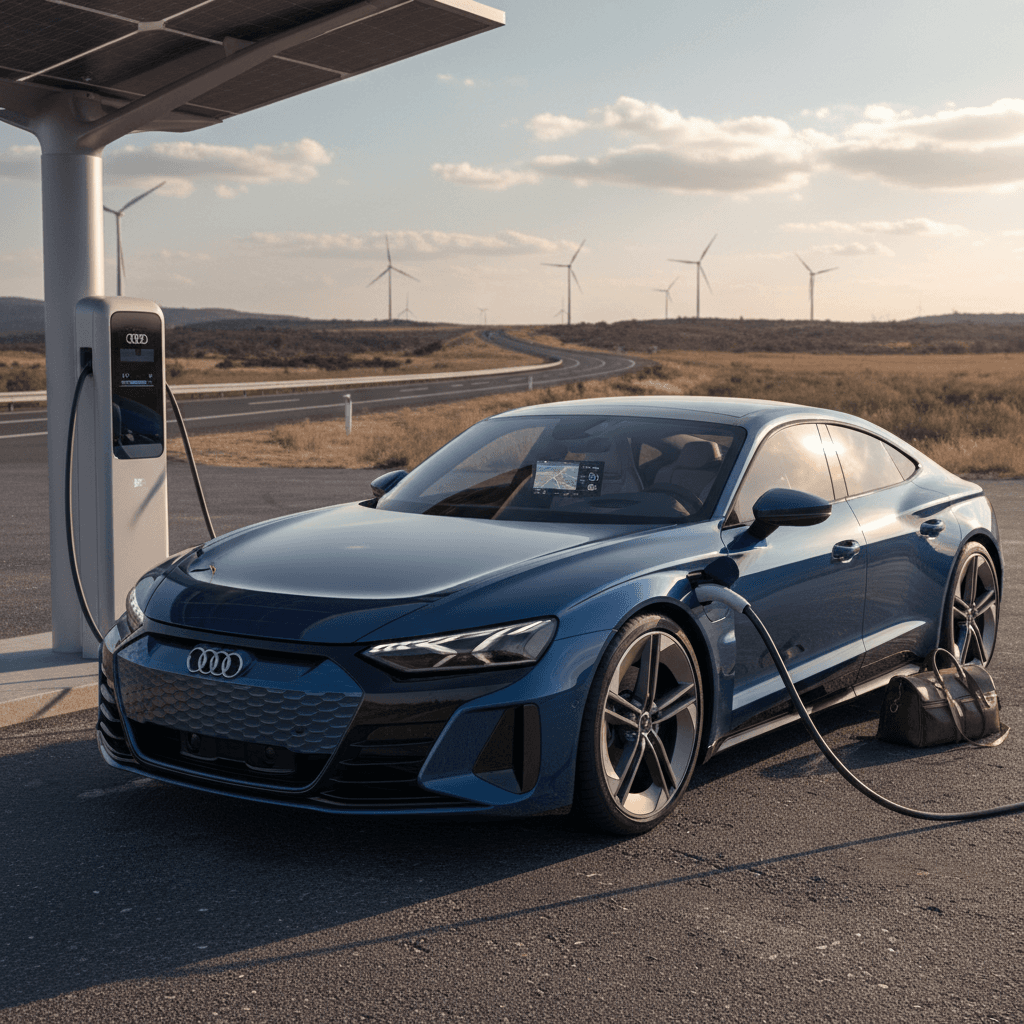
The Audi e-tron GT is built for covering serious miles, dual-motor Quattro grip, 800‑volt charging, and real grand‑touring comfort. But to get the most out of it on long-distance drives, you need to understand how range, charging, and comfort settings play together. These Audi e-tron GT long-distance driving tips will help you plan smarter road trips, avoid range anxiety, and spend more time driving than waiting at chargers.
Quick facts: Audi e-tron GT on the open road
Audi e-tron GT on long trips: what to expect
Where the e-tron GT shines
- Highway stability: Low center of gravity and Quattro all-wheel drive make it feel planted at speed.
- Fast charging: 800V architecture means some of the quickest 10–80% charge times in the segment when you find a capable DC fast charger.
- Refinement: Quiet cabin, supportive seats, and adaptive suspension make back‑to‑back 200‑mile stints realistic.
- Strong regen: Adjustable recuperation helps stretch range, especially on rolling terrain.
What can catch you out
- Speed sensitivity: Range drops quickly above ~75 mph, especially with 21‑inch wheels.
- Weather: Cold or very hot days can knock 10–25% off real-world range once you factor in HVAC.
- Fast charger quality: Older or shared chargers may not deliver enough power to see the impressive 250–300+ kW peaks the car is capable of.
- Trunk and frunk space: It’s a GT coupe, not an SUV, packing efficiently matters on longer family trips.
Key numbers for planning e-tron GT road trips
Know your real-world range before you leave
The number on your e-tron GT’s spec sheet is a starting point, not a guarantee. Before any long-distance trip, you should calibrate your expectations based on how your car, and your driving style, actually behave on the road. That’s especially important on earlier U.S. models with the smaller usable pack and on cars running big 21‑inch wheels or stickier performance tires.
Baseline your Audi e-tron GT range in 3 drives
1. Do a full 100–20% highway loop
On a normal weekend, charge to 100%, reset your trip computer, drive at your typical highway speed for 80–120 miles, then note remaining state of charge at 20–30%. This gives you a realistic consumption figure (mi/kWh or kWh/100 mi) at your usual pace.
2. Repeat in different conditions
Run the same loop once in mild weather and once in either cold or hot conditions using climate control normally. Compare the numbers, you’ll see how much HVAC and temperature impact your real-world range.
3. Translate consumption to safe range
Take the more conservative (higher) consumption number and multiply by your car’s usable battery capacity. Then plan long trips using **70–80% of that theoretical range** as your maximum between fast charges to leave a safety buffer.
Think in buffers, not best case
Optimize driving modes, speed and climate control
Audi gives the e-tron GT several drive modes, often including **Efficiency, Comfort, Dynamic, and Individual**, and they make a noticeable difference to long-distance efficiency. The art is balancing comfort with restraint so you still enjoy the GT without burning through energy.
Best driving-mode combinations for long-distance trips
Tune the e-tron GT’s personality to match your route
Efficiency mode on open highway
Use Efficiency when you’re cruising on mostly straight freeway with light traffic:
- Softer throttle mapping makes it easier to avoid wasteful bursts of power.
- Top speed may be slightly limited, helpful where enforcement is strict.
- HVAC can be dialed back a bit to save energy, especially if you preconditioned while plugged in.
Comfort mode for mixed driving
On routes that mix towns, on-ramps, and winding sections, Comfort often strikes the best balance:
- Normal throttle and steering but still efficient enough if you’re disciplined with your right foot.
- Suspension calibration helps keep passengers relaxed on long days.
- Good default if multiple people share the driving.
Individual mode for enthusiasts
If you want some fun without destroying range, set up Individual like this:
- Powertrain closer to Comfort or Efficiency.
- Steering and suspension a bit sportier for better feel.
- Regen set higher for one‑pedal‑style driving in traffic.
Use full Dynamic only in short bursts, it’s addictive and very energy hungry.
- Aim for **65–75 mph** on long highway stretches. Above that, aerodynamic drag ramps up, and you’ll see consumption rise sharply.
- Use **cruise control** when traffic allows; it’s better at holding a steady speed than most humans and helps smooth out unnecessary accelerations.
- In cold or hot weather, **precondition the cabin** while the car is still plugged in. That way the pack and interior are at a good starting temperature before you hit the highway.
- Favor **seat and steering-wheel heaters** over cranking cabin air temperature; they use less energy for the same perceived comfort.
- Check tire pressures before leaving, underinflated, wide performance tires can sap several percent of your range over a long day.
Watch those 21‑inch wheels
Smart DC fast-charging strategy for the e-tron GT
The e-tron GT’s 800‑volt architecture and strong charging curve are its superpower on road trips, but only if you use them correctly. The goal is to spend less time charging by **charging more often, but in the sweet spot** of the battery’s fast-charging window.
Ideal DC fast-charging windows for Audi e-tron GT
Target state-of-charge (SoC) ranges to maximize miles gained per minute of charging.
| Trip scenario | Arrive at charger | Unplug at charger | Why it works |
|---|---|---|---|
| Normal conditions, dense charging network | 10–15% | 70–80% | Stays in the most power‑dense part of the charging curve; minimizes tapering time above ~80%. |
| Sparse chargers, unknown reliability | 15–25% | 80–90% | Builds in extra buffer in case the next site is busy or partially offline. |
| Very cold or very hot weather | 10–20% | 70–80% | Leaves time margin if charge rates are lower than expected due to pack temperature or station derating. |
| Destination charging overnight | 20–40% | 80–100% (AC) | Use slower Level 2 to top off near 100% shortly before departure without stressing the pack. |
These are guidelines; adapt for weather, charger availability and your own risk tolerance.
Always precondition to the charger
- Favor **150–350 kW stations** on major corridors. The car will only pull what it can, but a higher‑rated stall is less likely to be the bottleneck.
- If a site is busy, avoid stalls **sharing a cabinet** when possible, shared power can slash your peak rate.
- Don’t chase 100%. Once you’re past 80–85%, each extra percent takes disproportionately longer and doesn’t usually help your schedule.
- Use charging time strategically: restrooms, snacks, stretching, and quick emails. On an efficient road trip, your 15–20‑minute stop is barely longer than a traditional gas/rest break.
Route planning and charger selection
Long-distance EV driving is as much about **planning tools** as it is about the car. The e-tron GT’s built‑in navigation can factor in traffic and charging, but pairing it with one or two specialist apps makes road trips smoother, especially across varied charging networks in the U.S.
Tools that make Audi e-tron GT road trips easier
Combine OEM navigation with EV‑focused planners
In-car Audi navigation
- Understands your car’s consumption and SoC in real time.
- Can suggest charging stops directly along your route.
- Triggers battery preconditioning when you route to a compatible DC fast charger.
Use this as your primary guidance so the car manages its own energy expectations.
Third-party EV route planners
Apps and web tools like EV‑specific planners are great for pre‑trip research:
- Simulate routes at your preferred speed and weather.
- Compare different legs and charger options.
- See user‑reported reliability and amenities at each site.
Network and station apps
- Check live charger status, pricing, and maximum power for each stall.
- See whether sites are crowded before you arrive.
- Start sessions or unlock membership rates without fumbling with a wallet at the station.
Plan a backup charger for each stop
For U.S. drivers, think in terms of **corridors** (I‑5, I‑95, I‑80, etc.). Most high‑output DC fast chargers sit right off these major interstates, and the e-tron GT’s strong charging curve means you can comfortably hop from site to site. If you routinely travel secondary highways, scout ahead for Level 2 options at hotels, restaurants, and attractions to top up while you’re stopped anyway.
Maximizing comfort without killing your range
The whole point of a grand tourer is to arrive relaxed. You don’t have to freeze or sweat to get good efficiency from an Audi e-tron GT, but a few habits help you keep both comfort and range in play.
Cabin comfort settings
- Use auto climate at a moderate setpoint (around 70–72°F) and let the car do the rest.
- In cold weather, rely more on seat and steering-wheel heaters; they give high perceived warmth for relatively low power draw.
- Keep the cabin closed at higher speeds. Open windows and sunroof dramatically increase drag on a sleek car like the e-tron GT.
- On hot days, pre‑cool the car while plugged in and use recirculation once you’re at a comfortable temperature.
Driver fatigue and ergonomics
- Take advantage of adjustable lumbar support and seat bolstering, small tweaks every couple of hours prevent stiffness.
- Use driver‑assist features like adaptive cruise and lane centering when appropriate, but stay engaged. These systems reduce effort on monotonous stretches.
- Structure your day around your charging stops: every 2–3 hours, stretch, hydrate, and walk a few minutes while the car charges.
- Share driving duties when possible; the e-tron GT’s instant torque makes it deceptively easy to overdrive when you’re tired.
Comfort and efficiency can coexist
Battery health and long-term road-trip habits
Audi’s pack management is conservative, and the e-tron GT includes an 8‑year/100,000‑mile battery warranty in many markets. That said, your long-distance driving habits can influence how much usable range you keep over time, especially if you travel frequently in extreme climates.
- Reserve **100% charges for trip days**. For everyday use, set your charge limit closer to 70–80% to reduce time at very high state of charge.
- On road trips, it’s fine to hit 100% occasionally, just don’t leave the car sitting at 100% for hours in the hot sun.
- Avoid repeated 0–1% arrivals. Rolling into a charger at 5–10% regularly is fine; going flat isn’t good for peace of mind or the pack.
- If you’re doing several back‑to‑back fast charges on a hot day, expect the car to manage pack temperature and sometimes limit peak charge rates, that’s normal behavior designed to protect the battery.
- Use **strong but not maximum regen** for most driving. It recovers energy without relying too heavily on friction brakes, and it doesn’t harm the battery.
Don’t ignore software updates
Extra tips if you’re road-tripping a used Audi e-tron GT
A growing number of Audi e-tron GTs are entering the used market, which is where Recharged lives every day. A well‑kept used GT can be a phenomenal long-distance companion, as long as you go in with eyes open about battery health, range, and charging behavior.
Used e-tron GT road-trip checklist
What to verify before your first long highway run
Check battery health and range
- Look at the car’s projected range after a 100% charge and compare it to new‑car estimates.
- Take a highway shakedown drive to see **real consumption** (mi/kWh or kWh/100 mi) before committing to a big trip.
- Ask for any available battery health reports. Every Recharged vehicle comes with a Recharged Score that includes verified battery diagnostics and fair‑market pricing context.
Inspect charging hardware and cables
- Confirm the car’s DC fast-charging port is clean and undamaged.
- Test both AC home charging and at least one DC fast-charging session to ensure the car reaches expected power levels.
- Make sure the included Level 1/2 portable charger and any adapters are present and in good shape.
Review service and software history
- Ask whether any battery or high-voltage system work has been done and confirm it was performed by qualified technicians.
- Verify the latest software updates, especially those related to charging and driver-assistance systems, are installed.
- Confirm remaining battery warranty coverage by mileage and years.
Test comfort on a long loop
- Do a 60–90 minute mixed drive with your typical passengers and luggage weight.
- Check for any noises, vibrations or alignment issues at highway speeds.
- Fine‑tune seat, steering wheel and climate presets so your first real road trip starts from a dialed‑in baseline.
How Recharged can help
Audi e-tron GT long-distance driving FAQ
Common questions about Audi e-tron GT road trips
Key takeaways for confident Audi e-tron GT road trips
Treat your Audi e-tron GT like what it is: a high‑performance grand tourer with a serious battery and one of the best fast‑charging setups on the market. If you baseline your real‑world range, stick to smart charging windows, and let the car’s navigation and preconditioning do their job, you can cover hundreds of miles per day with minimal downtime and little drama.
For shoppers looking at a **used Audi e-tron GT** specifically for long-distance driving, the key variable is battery health and realistic highway range. That’s where Recharged comes in. Every vehicle we list includes a **Recharged Score battery health report**, fair market pricing, and EV‑specialist guidance on charging, financing, trade‑in, and delivery. Whether you’re planning a cross‑country blast or regular interstate runs, the right e-tron GT, properly understood, is more than up to the task.