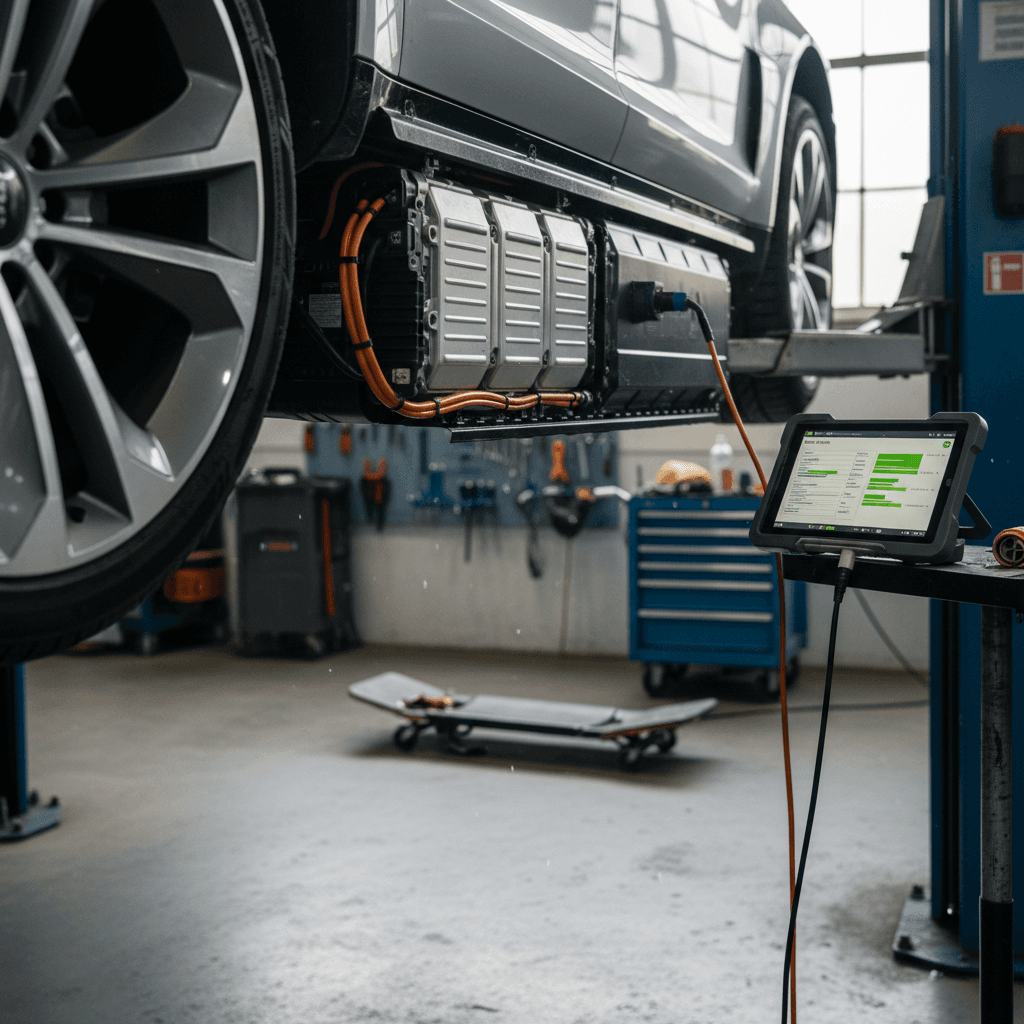
If you own, or are eyeing, a used Audi e-tron GT, battery health is the whole ballgame. The car’s pace, range, warranty coverage, and long‑term resale all orbit that big lithium‑ion pack under the floor. This guide walks you through exactly how to check Audi e-tron GT battery health, from quick DIY checks to dealer diagnostics and third‑party reports, so you’re not guessing about the most expensive part of the car.
Battery health vs. battery charge
Why battery health matters on an Audi e-tron GT
Three reasons battery health is a big deal
Especially for performance EVs like the e-tron GT
Real-world range
Performance consistency
Resale & financing
What Audi’s battery warranty really promises
Audi backs the e-tron GT’s high‑voltage battery with an 8‑year / 100,000‑mile (in many markets) high‑voltage battery limited warranty. Within that window, Audi typically guarantees that the pack will retain roughly around 70% of its original usable capacity, assuming the car has been used and maintained according to the owner’s manual. Exact terms and thresholds can vary slightly by region and model year, so always confirm in your own warranty booklet and with a dealer.
- Warranty covers defects in materials/workmanship and excessive capacity loss, not every minor drop in range.
- Audi (or an authorized retailer) uses factory diagnostics to measure net battery energy content in kWh, not just a guess from the dash.
- If measured capacity falls below Audi’s thresholds during the warranty period, the battery (or modules) can be repaired or replaced to bring it back up to the specified minimum.
Don’t assume 100% forever
Quick in-car checks for battery health
You can’t see a factory‑certified state‑of‑health percentage from the driver’s seat, but the e-tron GT gives you a surprising amount of indirect data. Before you pay anyone for a formal test, walk through these simple in‑car checks.
DIY checks before you book a diagnostic
1. Compare indicated range at 100%
Fully charge the car (preferably on AC overnight) and note the indicated range in "Efficiency" mode. Compare that to the EPA‑rated figure for your model year and wheel/tire combo. A healthy pack, in mild weather and with normal driving history, will typically show an estimate in the same ballpark once the car has learned your driving style.
2. Reset or note trip data
Zero out a trip meter, then drive a consistent route (mixed city/highway) for 30–50 miles. Record energy consumption in kWh/100 mi or mi/kWh. Plug that into a simple calculation: usable battery capacity × efficiency ≈ expected range. If the math suggests dramatically less energy available than spec, it may warrant a deeper check.
3. Check efficiency screens
Use the MMI’s <strong>Vehicle data / efficiency</strong> screens to see what’s eating energy: drivetrain, climate, auxiliary systems. If climate is doing the heavy lifting in extreme heat or cold, apparent “poor range” might be about HVAC use, not a sick battery.
4. Look for power limits
On a warm battery at mid‑to‑high state of charge, the e-tron GT should deliver full power without persistent yellow power‑limit warnings. Frequent, unexplained power reductions can point to thermal management issues or other faults that deserve a diagnostic scan.
5. Listen for thermal system overwork
It’s normal to hear pumps and fans after a DC fast‑charge or hard driving. But if fans are raging during gentle use or mild temperatures, it can be a sign the car is working harder than it should to keep the pack in its comfort zone.
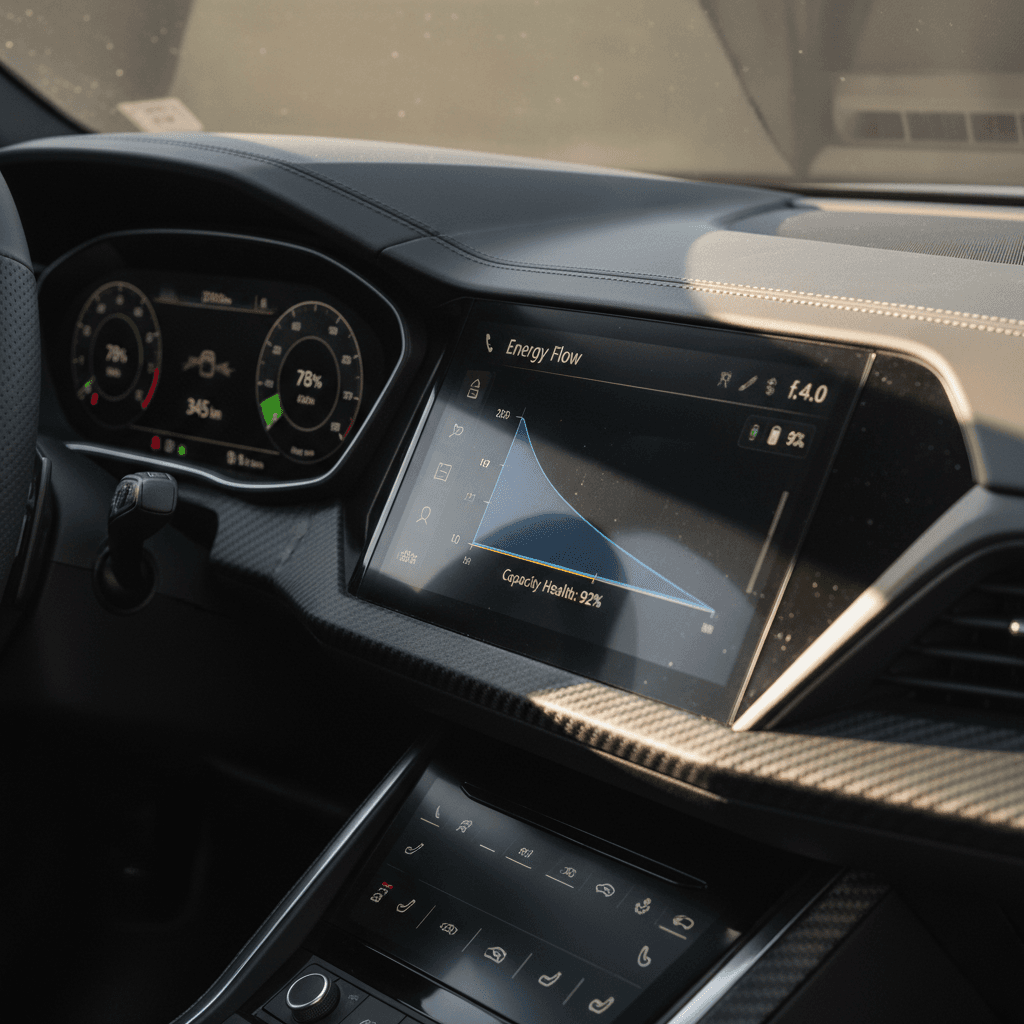
Use consistent conditions
Reading efficiency and real-world range
The e-tron GT lives and dies by efficiency. A pack with slightly reduced capacity but very good efficiency can feel healthier in daily use than a full‑capacity pack driven like it’s late for a flight. To separate driver behavior from genuine degradation, you need a little back‑of‑the‑envelope math.
Turning e-tron GT data into a rough SOH estimate
Use this as a sanity check, not a warranty‑grade measurement.
| Step | What to do | Example numbers | What it suggests |
|---|---|---|---|
| 1 | Find your usable battery size (approximate) | ~93 kWh usable on many e-tron GT variants | Reference point |
| 2 | Drive 50 miles on a steady route | Trip computer shows 2.4 mi/kWh average | 50 ÷ 2.4 ≈ 20.8 kWh used |
| 3 | Check SOC drop over that trip | Charge went from 80% to 57% (23% drop) | 0.23 × usable capacity ≈ kWh used |
| 4 | Compare the two kWh figures | 0.23 × 93 kWh ≈ 21.4 kWh vs. 20.8 kWh from trip | Close match: pack behaving near spec |
| 5 | Repeat a few times | Do similar drives in different weeks | Big, repeated mismatches justify a pro test |
Example uses rounded numbers; always check your specific model’s usable battery size.
Don’t use this to fight a warranty case
Dealer diagnostic battery health tests explained
When you want a definitive answer, especially if you’re near the edge of Audi’s warranty window, you’ll need the same tools the dealer uses. On the e-tron GT, that typically means an ODIS‑based high‑voltage battery test and, in some markets, an official battery health certificate.
What a dealer battery test usually involves
What the dealer actually checks
- High‑voltage battery state of health / usable capacity in kWh.
- Cell/module behavior and balancing performance.
- Thermal management system operation and error codes.
- Historical fault codes tied to fast charging, voltage limits, or overheating.
What you should ask for
- A printed or PDF summary showing measured capacity or SOH value.
- Any notes on unusual cell imbalance or thermal issues.
- Confirmation that results are within Audi’s published limits for your car’s age/mileage.
- Service advisor’s written comments attached to the RO (repair order).
Costs and availability vary
Independent and digital battery reports
Not every Audi dealer is eager to run a deep‑dive battery test on a car they’re not selling. That’s where third‑party platforms and independent specialists come in. For a car like the e-tron GT, complex, expensive, and still relatively new, having another set of eyes on the battery is smart money.
Ways to get a battery health report beyond the dealer
Layer your sources for maximum confidence
Specialist EV shops
Telematics & app data
Recharged Score report
Stack the deck in your favor
Ready to find your next EV?
Browse VehiclesWhat’s “normal” degradation on an e-tron GT?
Real‑world data on e-tron GT degradation is still accumulating, but we can sketch the outlines. Audi’s warranty structure implies that, under typical use, the company expects the pack to stay above roughly 70% usable capacity for eight years, and internal tables in some regions reference higher internal targets at three and five years for various e-tron models. That tells you Audi doesn’t see rapid, early battery collapse as normal.
- A mild initial drop is common in the first 1–2 years as the pack settles, followed by a slower decline.
- Hot climates, frequent DC fast charging, and lots of high‑speed driving tend to accelerate wear.
- Light use with lots of time sitting at 100% or near‑empty isn’t great either; batteries like the middle of the gauge.
Context matters more than a single number
How to check battery health when buying a used e-tron GT
With a used e-tron GT, you’re not just buying an Audi; you’re buying someone else’s charging habits. Here’s a practical checklist you can run whether you’re on a dealer lot, at a private driveway, or shopping online.
Battery health checklist for used e-tron GT shoppers
1. Ask for documented battery tests
Request any prior <strong>dealer battery health reports</strong>, high‑voltage warranty claims, or software updates related to charging or range. A fresh test within the last 6–12 months is best.
2. Review charging history
If the seller is comfortable sharing, look at their usage patterns: lots of daily DC fast charging, or always parked fully charged in hot sun, can be a yellow flag. Reasonable DC use plus primarily AC overnight charging is ideal.
3. Cross‑check indicated range
Fully charge the car and compare estimated range to what you’d expect for that model year and wheel/tire package. Make allowances for weather and driving profile, but flag any huge discrepancy.
4. Inspect tire, brake, and service history
Uneven tires and patchy service records can imply hard use or neglect, which tends to travel with poor charging discipline. A clean service history suggests the owner took the whole car seriously, including the battery.
5. Get an independent EV inspection
If you’re serious about a particular car, consider booking a third‑party EV specialist for a <strong>pre‑purchase inspection</strong> focused on the high‑voltage system, even if the selling dealer gives you a thumbs‑up.
6. Consider buying through Recharged
A used e-tron GT sourced through <strong>Recharged</strong> comes with a <strong>Recharged Score Report</strong>, including verified battery health, expert valuation, and guidance on long‑term ownership costs, so you don’t have to decode all this alone.
Habits that protect your e-tron GT battery
Once you’ve confirmed your e-tron GT is healthy, the game shifts from diagnosis to preservation. The good news: the same habits that keep the pack happy also make the car easier to live with.
Battery‑friendly habits for daily driving
Simple changes that pay off over 8+ years
Live on AC, not DC
Avoid living at 100%
Drive smoothly when cold
Don’t store it empty
Audi e-tron GT battery health FAQ
Frequently asked questions about e-tron GT battery health
Key takeaways for e-tron GT owners & shoppers
The Audi e-tron GT’s battery is both its beating heart and its bank vault. You don’t have to be an engineer to gauge its health, you just need a method. Start with smart DIY checks in the car, sanity‑check range and efficiency, then graduate to a dealer diagnostic or independent EV battery test when the stakes get higher. If you’re buying used, make documented battery health non‑negotiable, the way you’d demand a clean title on a sports car.
And if you’d rather not become a part‑time EV detective, platforms like Recharged are built for exactly this problem. Every used EV on Recharged comes with a Recharged Score Report that verifies battery condition, aligns pricing with reality, and pairs you with EV‑savvy support from first click to delivery. That way, when you floor an e-tron GT’s right pedal, the only thing you’re thinking about is the horizon, not the health of the kilowatt‑hours underneath you.