If you’re looking at an Audi e-tron GT, especially used, it’s natural to worry about battery degradation per year. The high-voltage pack is the most expensive component in the car, and its health directly affects range, performance, and resale value. The good news: with sane use, most e-tron GT owners are seeing modest, manageable degradation rather than catastrophic range loss.
Quick answer
Audi e-tron GT battery degradation per year: the basics
Let’s set expectations before diving into edge cases. No EV, including the Audi e-tron GT, keeps 100% of its original battery capacity forever. Lithium‑ion cells age with time, temperature, and use. But modern packs, especially in premium cars like the e-tron GT, are engineered with large buffers and conservative charging strategies to keep real‑world degradation fairly tame.
Typical battery degradation patterns (modern EVs, including e-tron GT)
EV degradation usually follows a non‑linear curve: a noticeable drop in the first 12–24 months, then a long, flatter period. Large‑battery performance cars like the e-tron GT tend to age slightly better than early mass‑market EVs because they run their packs well within safe limits rather than near the edge of usable capacity.
Don’t over-interpret the range estimate
What Audi’s battery warranty really promises
Across most markets, the Audi e-tron GT’s high‑voltage battery is covered for 8 years or around 100,000 miles (160,000 km), whichever comes first. The key phrase buried in the fine print: Audi will typically repair or replace the pack if its net capacity drops below about 70% of original within that period.
- Coverage term: usually 8 years / 100,000 mi (160,000 km) for the high‑voltage battery
- Capacity guarantee: pack should retain at least ~70% of its original energy capacity within that period
- Trigger: you typically need a dealer test that confirms capacity below the threshold
- Scope: coverage is for defects and excessive degradation, not abuse (e.g., accident damage)
Why 70% matters
This also frames the upper bound of "normal" degradation. If Audi is comfortable promising 70% after 8 years, it’s implicitly betting most cars will do substantially better under typical use, otherwise warranty costs would be painful.
Real-world e-tron GT degradation: what owners and data show
Audi doesn’t publish per‑year degradation curves for the e-tron GT, and public third‑party datasets are still thin compared with volume EVs. So the best perspective comes from combining general EV fleet data with early owner reports from e‑tron GT and close cousins like the Porsche Taycan, which shares battery architecture.
What we actually see in the wild
Pulling together large EV studies and early e-tron GT owner experiences
Early drop: 2–5%
Then 1–2% per year
e-tron family behavior
Because the e-tron GT has a large pack (93.4 kWh usable on early cars; ~105 kWh on updated models) and conservative buffers, even a 10% capacity loss is less noticeable than on a small‑battery EV. You’re starting from a big energy budget, so every lost kWh is a smaller slice of the pie.
How to interpret anecdotes
6 factors that speed up or slow down e-tron GT degradation
Every e-tron GT uses broadly similar battery chemistry, but two owners can see very different degradation depending on how they treat the car. If you’re trying to predict degradation per year, these six variables matter more than the badge on the trunk.
Key drivers of battery aging in the e-tron GT
1. Average state of charge (SoC)
Spending most of the time between <strong>20–80%</strong> SoC is easier on the pack than living near 100%. Letting the car sit full in hot weather is one of the fastest ways to age cells.
2. Fast charging vs AC charging
DC fast charging (especially repeated back‑to‑back sessions) warms the pack and stresses it more than Level 2 AC charging at home. Occasional fast charging is fine; making it your primary strategy accelerates wear.
3. Climate and parking
High ambient temperatures and sun‑baked parking accelerate chemical aging. The e-tron GT’s thermal management helps, but <strong>garaging the car</strong> and avoiding long periods in extreme heat pays off
4. Annual mileage and driving style
Higher mileage means more cycles, but also more highway driving, which tends to be gentler than lots of short, cold starts. Aggressive acceleration mostly hurts efficiency, not directly degradation, as long as temperatures stay in check.
5. Depth of discharge
Regularly bouncing between 0–100% (especially when combined with high power) is tougher on cells than shallow cycles like 30–70%. Try not to frequently run the car to 0% or charge to 100% for day‑to‑day use.
6. Software and BMS behavior
Audi’s battery management system (BMS) uses buffers and over‑provisioning. Over time, software updates can change how much of the pack is accessible, which can look like degradation even if the physical cells are still healthy.
Worst-case habits to avoid
How degradation actually affects e-tron GT range
Most people don’t think in kilowatt‑hours; they think in miles of range. So what does a typical degradation curve look like in daily driving when you translate percentages into usable miles on an e-tron GT?
Illustrative impact of battery degradation on e-tron GT range
Assuming an early e-tron GT with ~238 miles EPA combined range and similar efficiency over time.
| Battery health | Usable capacity vs new | Approx. EPA-style range | What you’d actually feel |
|---|---|---|---|
| 100% (brand new) | Baseline | ~238 mi | Full rated range in ideal conditions |
| 95% (1–2 yrs) | −5% | ~226 mi | A small drop, hard to notice without careful tracking |
| 90% (~4–6 yrs) | −10% | ~214 mi | You might plan one extra quick stop on very long trips |
| 80% (~10+ yrs, typical use) | −20% | ~190 mi | Still fine for daily use; some road trips require more planning |
| 70% (warranty floor) | −30% | ~167 mi | Noticeable loss; daily commuting OK, but long‑range touring less convenient |
These are rough, rounded numbers for illustration, not precise predictions for your specific car.
Because the e-tron GT is a performance sedan with generous power reserves, you’re more likely to notice degradation as reduced highway range than as a loss of acceleration. The car will still be very quick even if the pack has aged; you’ll just have fewer miles between charges.
How to evaluate a used Audi e-tron GT’s battery
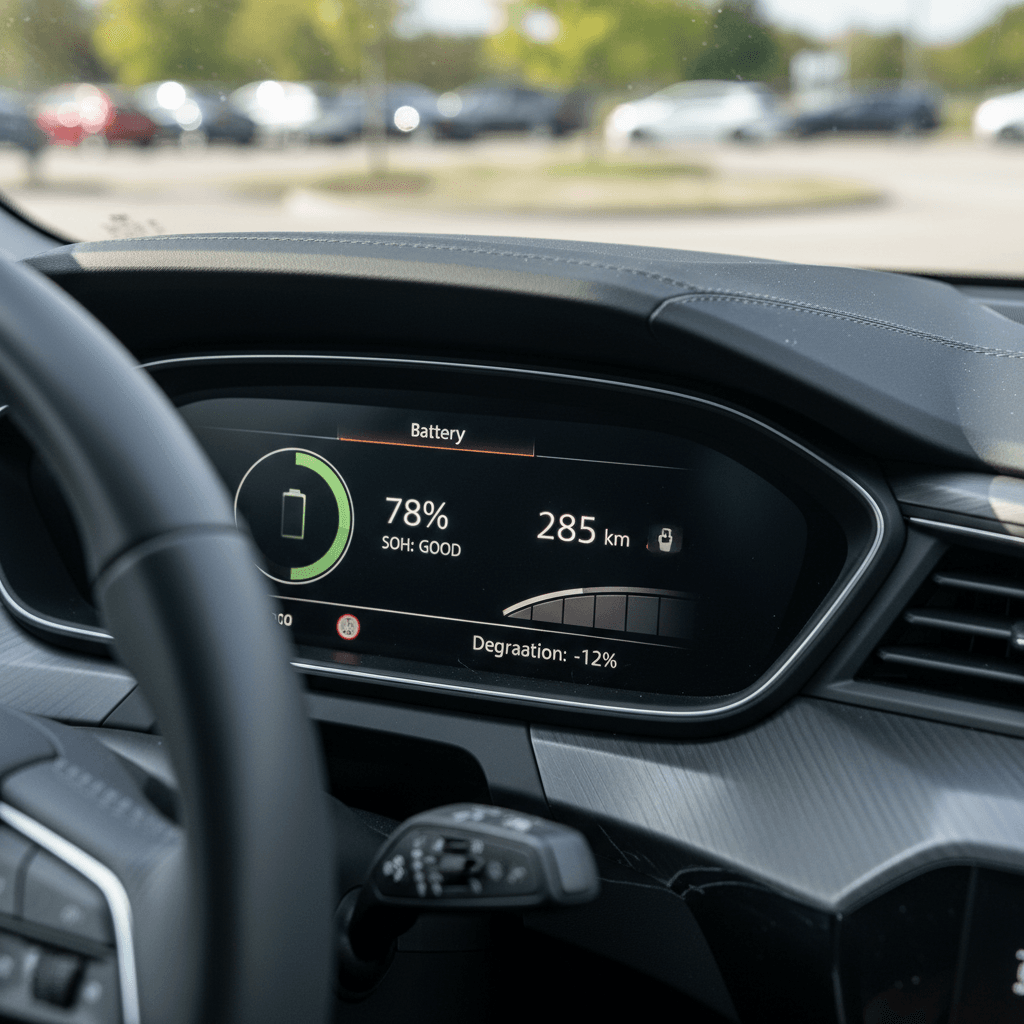
If you’re shopping used, especially for a 2021–2023 e-tron GT, battery health should be as important as options and wheel size. The challenge is that factory state‑of‑health readouts are not always transparent or directly exposed, and guessing from the dashboard range estimate is unreliable.
1. Start with paperwork and warranty status
- Confirm the in-service date to know how much of the 8‑year battery warranty remains.
- Check for completed recalls or battery-related service campaigns.
- Look for documentation of unusual battery work or replacement.
2. Look at usage pattern, not just miles
- High mileage with mostly highway use can be easier on a pack than low mileage with lots of fast charging.
- Ask how the car was typically charged (home Level 2 vs frequent DC fast charging).
- Climate history matters: a life in Phoenix is harder than one in coastal Oregon.
Used e-tron GT battery health checklist
Confirm remaining battery warranty
Ask the seller or dealer to confirm the high‑voltage battery warranty end date and mileage limit, and get it in writing on the purchase paperwork.
Request a documented battery health report
Ideally, you want a <strong>third‑party test or dealer report</strong> that estimates usable capacity in kWh, not just a generic “battery OK” note.
Compare range to similar cars
On a full charge, compare the projected range to what other e-tron GT owners with similar driving patterns see. Big outliers (e.g., 20–30% less) warrant deeper investigation.
Test both cold and warm behavior if possible
If you can, observe the car on a cold day and a mild day. Huge swings in indicated range and sudden SoC drops at low state‑of‑charge can hint at a weak pack or poor balancing.
Scan for warning lights or power limits
No persistent battery, drivetrain, or charging warnings should be present. Limp‑mode behavior or reduced DC fast‑charge speeds can indicate underlying issues.
Where Recharged fits in
Ready to find your next EV?
Browse VehiclesHow to protect your e-tron GT battery and slow degradation
Whether you buy new or used, how you treat your e-tron GT from here forward will largely determine your personal degradation curve. You don’t have to baby it, but a few habits make a real difference over 8–10 years of ownership.
Owner habits that pay off over years
Simple choices that keep your e-tron GT’s battery healthier, longer
Live between 20–80% most days
Favor Level 2 over DC fast charge
Avoid hot, full storage
- Keep software up to date so the BMS and thermal controls are using Audi’s latest strategies.
- Check tire pressures and alignment, poor efficiency from underinflated tires can be mistaken for degradation.
- Use preconditioning when fast‑charging in cold weather; it brings the pack into an optimal temperature window.
- Consider a lower charging limit (60–70%) if you mostly do short city commutes and don’t need big range.
Drive it like a car, not a lab experiment
Recalls, replacements, and warranty considerations
Some early e-tron GTs and their Taycan siblings have seen battery‑related recalls, including campaigns where Audi advised owners to limit charge to 80% until a repair was performed. A recall isn’t automatically a reason to walk away, but it is a reason to verify the car’s service history carefully.
If a recall applied to your car
- Confirm the recall has been completed at an Audi dealer.
- Ask what parts were replaced (entire pack, modules, or just software).
- If the pack was replaced, clarify whether the warranty clock on the replacement pack is new or tied to the original in‑service date.
If you’re evaluating a recalled VIN
- A properly completed recall can actually be a plus: you’re getting updated components or software.
- Use the recall as leverage to request fresh battery diagnostics as part of the sale.
- If the seller can’t prove the recall was done, budget time and hassle to complete it after purchase.
Don’t assume any EV battery is "lifetime"
FAQ: Audi e-tron GT battery degradation per year
Frequently asked questions
Bottom line: should you worry about e-tron GT battery degradation?
If you zoom out from internet horror stories and look at how modern EVs age in the real world, the Audi e-tron GT’s battery story is fairly encouraging. With typical usage, you’re looking at single‑digit percentage loss over the first few years and perhaps 15–25% over a decade, very much in line with Audi’s own warranty posture and broader EV data.
Where things go sideways is usually not brand‑specific, but behavior‑specific: relentless fast charging, parking full in extreme heat, or neglecting obvious warning signs. If you’re buying used, the smart move is to treat battery health like you would a pre‑purchase inspection on an engine, get real diagnostics, not just a quick test drive and a handshake.
That’s exactly why Recharged bakes a Recharged Score Report and verified battery health data into every EV we list. If you want an e-tron GT that will still deliver confident range and performance years from now, starting with a car whose pack you actually understand is the best way to stack the odds in your favor.