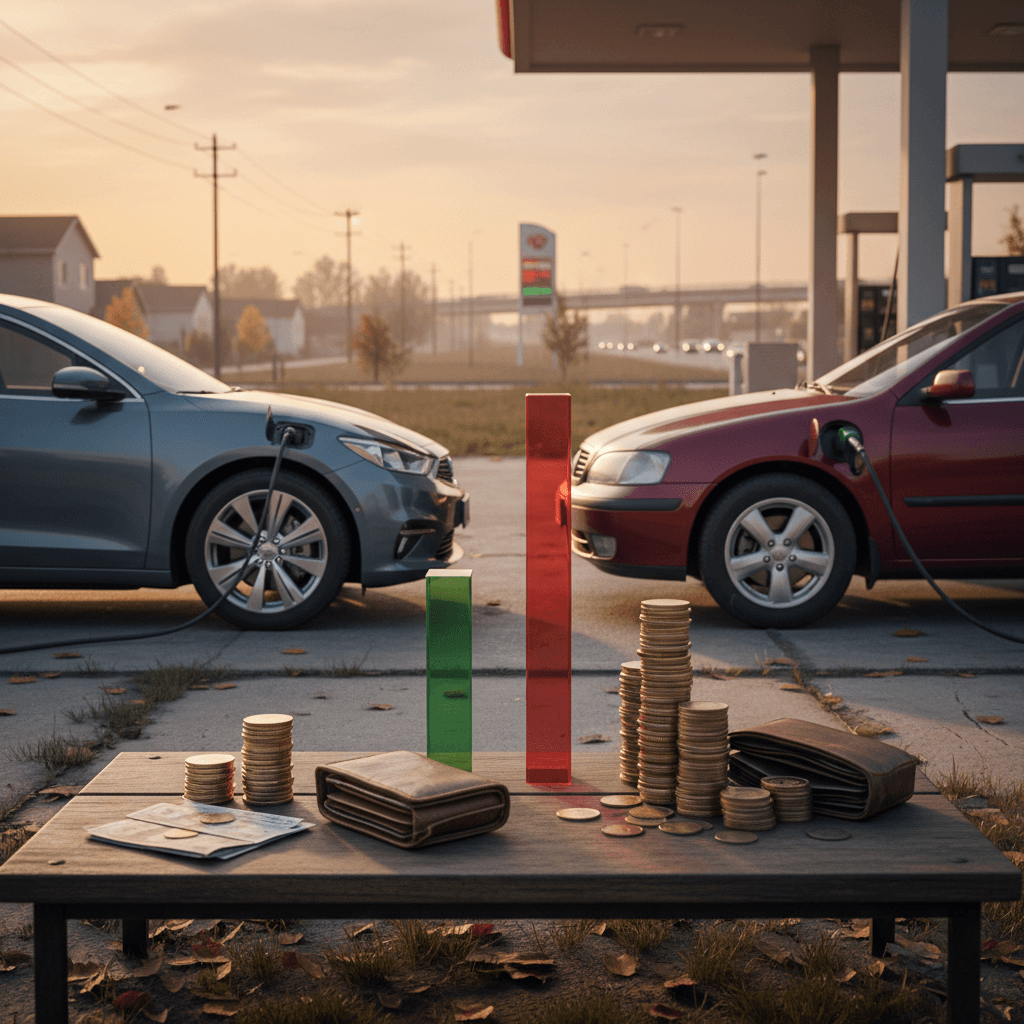
You’ve probably heard that electric cars are cheaper to own than gas cars, but you’ve also seen headlines about pricey batteries and higher insurance. So which story is true? In 2025, whether an electric car is cheaper to own than a gas car depends less on hype and more on a handful of concrete factors: fuel, maintenance, insurance, depreciation, and how you buy.
Key takeaway in one sentence
Are electric cars actually cheaper to own? The short answer
High-level EV vs gas ownership numbers (typical U.S. driver)
For a mainstream compact or midsize car, an EV usually costs more up front but less to run. Over 5–10 years, the savings from cheaper “fuel” (electricity) and maintenance generally outweigh the higher purchase price, particularly if you buy used, avoid ultra-rapid battery degradation, and don’t rely exclusively on expensive DC fast charging.
When a gas car can still be cheaper
How total cost of ownership really works
To answer whether electric cars are cheaper to own than gas cars, you have to look beyond the sticker price and think in terms of total cost of ownership (TCO). TCO adds up everything you actually spend over time, typically 5–10 years:
- Purchase price (minus tax credits or rebates)
- Financing costs (interest, fees)
- Fuel (electricity or gasoline)
- Maintenance and repairs
- Insurance
- Taxes, registration, and any EV-specific fees
- Depreciation (how much value the car loses)
Different drivers sit at different points in this equation. A high‑mileage commuter who can charge at home will see a bigger EV advantage than someone who mostly walks and only drives on weekends. The rest of this guide breaks TCO down piece by piece so you can plug in your own situation.
Fuel costs: electricity vs gasoline
What a gas car really costs to fuel
Take a typical gas sedan that gets around 30 mpg combined.
- 10,000 miles/year = about 333 gallons of gas.
- At $3.50 per gallon, that’s roughly $1,165 per year.
If gas is $4.00, that same driving jumps to about $1,333/year. If it drops to $3.00, you’re still spending around $1,000/year.
What an EV costs to "fuel"
Now consider an efficient EV that uses around 28 kWh per 100 miles.
- 10,000 miles/year = about 2,800 kWh.
- At a typical U.S. home rate of $0.16 per kWh, that’s about $450 per year.
Even if your home rate is closer to $0.20 per kWh, you’re still around $560/year, roughly half or less of what you’d spend on gasoline.
Use your own numbers
How public charging changes the math
Home charging is cheapest, but not everyone has it
Mostly home charging
If you charge at home 80–90% of the time and only occasionally use public fast charging, you’ll capture nearly all of the fuel savings an EV can offer.
Mixed home + public
Splitting charging between home and paid public stations trims your savings, but EV fuel costs typically still beat gasoline unless public rates are very high.
All public fast charging
Relying mostly on DC fast charging at highway rates can push EV fueling costs close to, or even above, gas, especially in high‑priced regions.
Maintenance and repairs: where EVs quietly win
The average gas car has hundreds of moving parts in its engine and transmission. An EV has a motor, inverter, and a single‑speed gearbox. That simplicity shows up in your long‑term bills.
Typical maintenance items: gas vs electric
What you’ll still pay for, and what disappears
Gas car routine costs
- Oil and filter changes (2–4 per year)
- Spark plugs, belts, and hoses
- Transmission service
- Exhaust system repairs
- More frequent brake service
EV routine costs
- Tires (EVs can wear them slightly faster)
- Brake fluid changes
- Cabin air filters
- Occasional coolant for battery/thermal system
- Far less brake work thanks to regen
Real‑world maintenance savings
There are exceptions, of course. Out‑of‑warranty EV repairs can be expensive if they involve the high‑voltage battery or specialized components. But those failures are still relatively rare compared with everyday gas‑engine issues, and many EV batteries are covered for 8–10 years or 100,000 miles or more.
The big fear: battery replacement costs
Insurance, taxes, and fees
Insurance is where the EV vs gas comparison gets murkier. In some markets, insurers charge slightly higher premiums for EVs because of higher repair costs and limited repair networks. In others, rates are similar to gas equivalents.
- Compact and midsize EVs often cost only a little more to insure than similar gas cars, especially as repair networks mature.
- Luxury EVs with aluminum bodies and advanced sensors can be noticeably more expensive to insure than basic gas cars.
- Some states add small annual EV registration fees to replace lost gas tax revenue, but these are usually outweighed by fuel savings if you drive a normal amount.
Get quotes before you buy
Depreciation and resale value
Depreciation, the loss of value over time, is often the single biggest cost of owning any car, gas or electric. Here’s where the story has shifted quickly for EVs:
How EV depreciation has changed
Early EVs, especially short‑range models, depreciated brutally as technology improved. More recently, price cuts from major EV makers and rapid model updates have also hit used EV values.
The upside for buyers: a 3‑ to 5‑year‑old EV can sell for a fraction of its original price while still offering plenty of life and range.
Why gas cars aren’t immune
Gas cars also depreciate, and in some segments the market is now anticipating a long‑term shift toward electrification. That can put pressure on resale values for inefficient or niche gas models.
But depreciation varies wildly by model. A popular hybrid or efficient gas crossover might hold value surprisingly well.
New EV vs used EV vs gas
Used EVs: where the savings really add up
If you’re focused on whether an electric car will be cheaper to own than a gas car, the used market is where the numbers often move from "slight advantage" to "no‑brainer."

Illustrative 5‑year cost comparison: used EV vs used gas car
Simplified example for a U.S. driver doing 10,000 miles/year, comparing a 3‑year‑old EV and a 3‑year‑old gas car at similar purchase prices.
| Cost category | 3‑yr‑old EV | 3‑yr‑old gas car |
|---|---|---|
| Purchase price (used) | $24,000 | $22,000 |
| Fuel (5 years) | ≈ $2,500 | ≈ $5,800 |
| Maintenance & repairs | ≈ $2,000 | ≈ $3,500 |
| Insurance (5 years) | ≈ $6,500 | ≈ $6,000 |
| Registration/fees | ≈ $1,000 | ≈ $800 |
| Estimated depreciation | -$9,000 | -$8,000 |
| Total 5‑yr cost (before resale) | ≈ $25,000 | ≈ $28,100 |
Numbers are illustrative, not quotes. Always run your own math based on local prices and real vehicles you’re considering.
In this kind of scenario, the EV ends up roughly $3,000 ahead over 5 years even though it cost a bit more to buy and slightly more to insure. Tweak the assumptions, higher gas prices, more miles, cheaper electricity, or a federal used‑EV tax credit, and the EV advantage grows.
Why battery health matters most in used EV math
Simple EV vs gas cost comparison table
Here’s a simplified side‑by‑side look at common ownership costs for a typical compact/midsize car in the U.S., assuming 10,000 miles per year and mostly home charging for the EV.
Typical annual ownership costs: EV vs gas (illustrative)
Actual numbers will vary by model, location, driving style, and energy prices. Use this as a framework for your own calculation.
| Category | Electric car | Gas car |
|---|---|---|
| Fuel / energy | $450–$650 | $1,000–$1,350 |
| Maintenance & repairs | $400–$700 | $700–$1,100 |
| Insurance | $1,200–$1,700 | $1,100–$1,600 |
| Registration/EV fees | $150–$250 | $100–$200 |
| Depreciation (new, per year) | $2,500–$4,000 | $2,000–$3,500 |
EV usually wins on fuel and maintenance; gas can be closer on insurance and depreciation depending on the vehicle.
Beware of averages
Checklist: Will an EV be cheaper for you?
Run this quick test before you buy
1. Estimate your annual miles
If you drive more than about <strong>8,000–10,000 miles per year</strong>, the EV’s lower fuel and maintenance costs are more likely to outweigh higher purchase or insurance costs.
2. Check your home charging situation
Can you install a Level 2 charger or at least use a regular outlet overnight? The more you can <strong>charge at home or work</strong>, the bigger your savings compared with gasoline and public fast charging.
3. Compare real insurance quotes
Get insurance quotes for the exact EV and gas car you’re considering, with identical coverage. A $200/year difference is small; an $800/year gap can significantly change the total cost picture.
4. Look up local electricity and gas prices
Use your utility bill to find your cents/kWh, and a local station price for $/gallon. Plug those into a simple calculator or spreadsheet using the example formulas from this article.
5. Decide how long you’ll keep the car
EVs shine over <strong>longer ownership periods</strong>. If you tend to keep cars 7–10 years, long‑term fuel and maintenance savings matter more than short‑term depreciation swings.
6. If buying used, demand battery transparency
Don’t just accept “battery seems fine.” Look for <strong>verified battery‑health data</strong>. On Recharged, every used EV comes with a Recharged Score Report so you can see pack health and how it impacts value.
How Recharged helps you lower EV ownership costs
Most buyers don’t have the time, or the data, to untangle every variable in EV vs gas ownership. That’s exactly the problem Recharged was built to solve for used EVs.
Four ways Recharged improves your EV cost of ownership
From battery health to financing, the focus is on total cost, not just price tags
Verified battery health
Every car on Recharged includes a Recharged Score Report with battery diagnostics, so you know how much real‑world range and life you’re buying.
Fair market pricing
Pricing reflects actual battery condition, mileage, and market data, helping you avoid overpaying for a car with hidden degradation.
Financing built for EVs
Recharged offers EV‑friendly financing and an instant offer or consignment options for your trade‑in, so you can see the full financial picture in one place.
Digital buying & delivery
Shop online with EV‑specialist support, then get nationwide delivery or visit our Experience Center in Richmond, VA to test drive and ask questions in person.
Ready to find your next EV?
Browse VehiclesPutting it all together
FAQ: Electric car vs gas car ownership costs
Frequently asked questions about EV vs gas ownership costs
Bottom line: When are EVs cheaper than gas cars?
When you add everything up, electric cars are usually cheaper to own than gas cars over a 5–10 year window if you (1) drive a typical amount, (2) can charge at home or work, and (3) choose your specific vehicle wisely. Fuel and maintenance savings tend to be meaningful, and the used EV market now offers plenty of options where the biggest depreciation hit has already happened.
Where EVs can struggle is in edge cases: very low‑mileage drivers, people who rely entirely on expensive public fast charging, or buyers who pay top‑dollar for bleeding‑edge models that may face rapid price cuts. That’s why looking at your actual driving and energy reality is more important than generic averages.
If you’re leaning toward a used EV and want to make sure the math really works in your favor, starting with Recharged gives you transparent battery health data, fair pricing, and EV‑literate support from first click to delivery. That turns the question from “Are electric cars cheaper to own than gas cars?” into a much more practical one: “Which specific EV will be the cheapest, and least stressful, to own for me?”