If you’re eyeing a 2025 Tesla Cybertruck, you’re not just buying a pickup, you’re buying a rolling conversation piece with serious performance, complicated tradeoffs, and more than a little drama baked in. This 2025 Tesla Cybertruck buying guide walks through trims, pricing, range, towing, reliability and whether you’re better off hunting for a used Cybertruck instead of joining the new‑truck hype.
Where the Cybertruck stands in 2025
Should you buy a 2025 Tesla Cybertruck?
Who the Cybertruck actually fits
- Performance junkies who love instant torque, wild styling, and tech‑heavy cabins.
- Occasional towers who pull a camper, boat or car trailer a few times a year and are willing to plan charging stops.
- Suburban owners with home charging and space to live with a big, angular truck.
- Early adopters who accept some risk with first‑gen hardware in exchange for bragging rights.
Who should probably pass
- Daily heavy towers who tow long distances for work, an electric truck’s range hit may drive you crazy.
- Rural drivers far from Tesla Superchargers or DC fast charging.
- Buyers obsessed with panel gaps and perfect paint, early Cybertrucks have typical Tesla build‑quality quirks.
- Budget shoppers who just need a basic work truck; cheaper, simpler options exist on gas or hybrid.
Start with your use case, not the truck
2025 Cybertruck trims, specs and pricing
As of late 2025, Tesla has shuffled the Cybertruck lineup more than once. The original rear‑drive base model came and went quickly; most shoppers will see two main flavors on the new‑vehicle configurator, plus a smattering of special or older builds on the used market.
Core 2025 Tesla Cybertruck numbers (approximate)
2025 Tesla Cybertruck trims at a glance
Key differences among the most common Cybertruck variants you’ll see new and used. Numbers are rounded; actual EPA figures and pricing change frequently.
| Trim | Drivetrain | Est. Range (mi) | Towing Max (lb) | 0–60 mph | Typical New Price* |
|---|---|---|---|---|---|
| Long Range (RWD) | Single‑motor RWD | ~340 | 7,500 | ~6.0 s | High $60Ks–low $70Ks when offered |
| AWD | Dual‑motor AWD | ~320–340 | 11,000 | ~4.1 s | Low–mid $80Ks depending on options |
| Cyberbeast | Tri‑motor AWD | ~300 | 11,000 | ~2.6 s | High $90Ks–$100K+ with options |
Always verify current pricing and range on Tesla’s site or the Monroney label for a specific truck.
Tesla keeps moving the goalposts
Beyond trims, a few options matter more than others for shoppers. The adaptive air suspension and rear‑steer hardware are standard on most builds and transform how the truck rides and maneuvers. Wheel choice affects both looks and range. And Tesla’s driver‑assist packages, from Autopilot to so‑called Full Self‑Driving, add thousands to the window sticker but may or may not suit how you actually drive.
High‑impact Cybertruck options to think about
These choices affect how the truck drives, how far it goes, and what it’s like to live with every day.
Wheels & tires
Cybertruck wheel packages can change range by double‑digit miles and noticeably alter ride and noise.
- All‑terrain tires look tough but hurt efficiency.
- Smaller wheels with taller sidewalls ride better.
Rear‑steer hardware
Standard on most trims, four‑wheel steering is a huge help for parking and tight streets in such a long truck.
On a test drive, pay attention to low‑speed maneuvering and U‑turns.
Driver‑assist packages
Enhanced Autopilot and Full Self‑Driving add cost today and come with ongoing software changes.
Decide if you truly need hands‑free highway help or if basic Autopilot is enough.
Range, towing and real‑world usage
On paper, the Cybertruck’s range and towing specs read like a moonshot: 300‑plus miles of range, 11,000 pounds of tow capacity, sports‑car acceleration. In reality, aero drag and weight are relentless enemies, especially at highway speed and especially with a trailer hung on the back.
Range claims vs. daily reality
What owners and testers are actually seeing on the road.
Unloaded driving
- In mild weather, many owners report 70–80% of rated range at 70–75 mph.
- Cold temps, headwinds and high speeds can eat another 10–20%.
- Plan highway legs around 200–230 miles between fast charges, not the full EPA number.
Towing a trailer
- With a mid‑size camper or car trailer, expect roughly half the rated range.
- Real‑world tests show big loads pushing consumption to 600–750 Wh/mi.
- On tow days, think 80–130‑mile hops between Superchargers, with more frequent, shorter charges.
The towing trap
Tesla has floated a bed‑mounted “range extender” battery pack to stretch total energy on board. That can help on specific use cases, but it eats cargo space and complicates loading. For most shoppers, the smarter move is to be brutally honest about how often you tow and how far. If it’s a ski boat to the local lake a few weekends a year, the Cybertruck can be brilliant. If it’s a car hauler to five states a month, think very hard.
Charging a Tesla Cybertruck
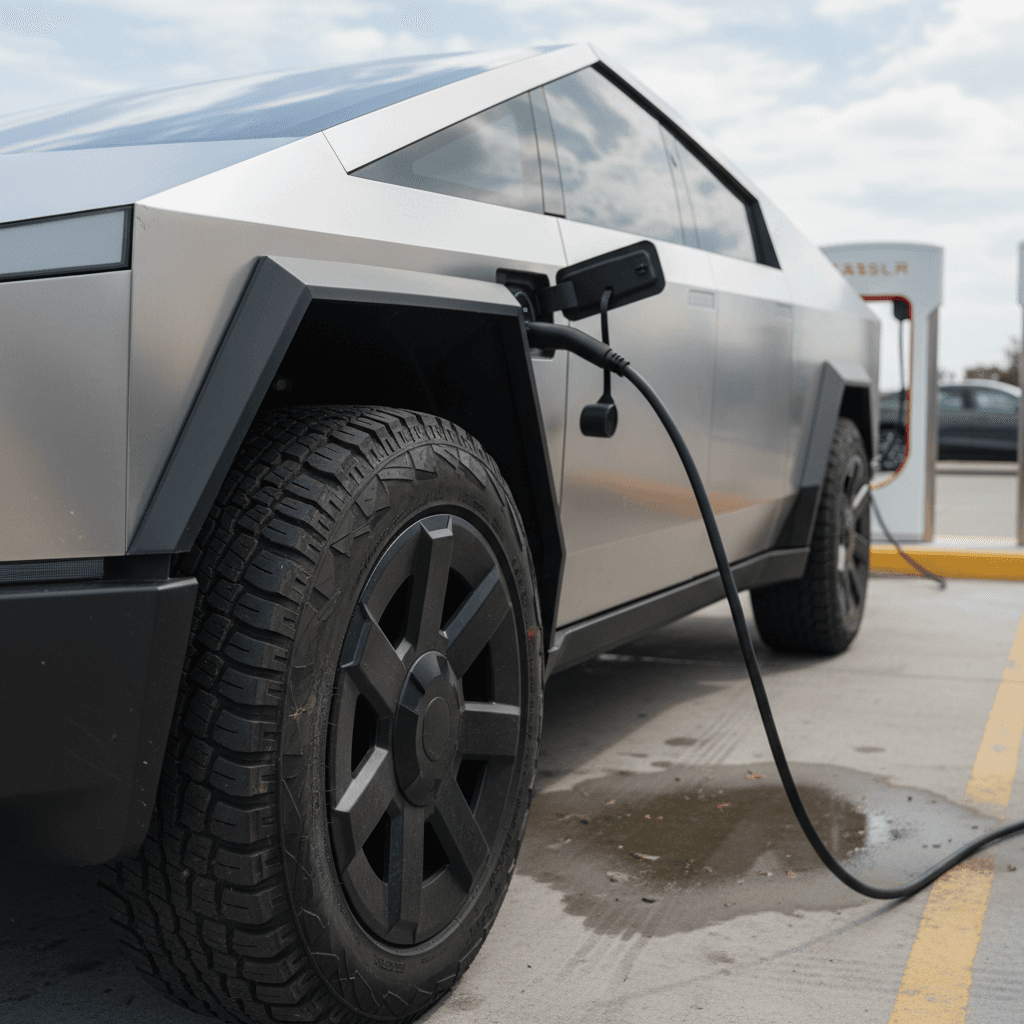
The Cybertruck uses Tesla’s NACS connector, now the de‑facto standard in North America. That gives you plug‑and‑play access to the Supercharger network and, increasingly, to third‑party DC fast chargers with NACS cables. For daily life, home charging is still the magic ingredient that makes a 7,000‑pound electric wedge feel normal.
- Onboard AC charger: around 11.5 kW, which means roughly 25–30 miles of added range per hour on a 240‑volt home circuit.
- Peak DC fast‑charging around 300–325 kW on compatible Superchargers, enough for a 20–80% top‑up in roughly half an hour under ideal conditions.
- Charging speed tapers as the battery fills, in cold weather, or if the pack is hot from hard driving or repeated fast charges.
- At home, most owners set a daily charge limit around 70–80% and only go to 100% before long trips.
Plan home charging before you buy
Ownership costs, depreciation and value
Sticker shock is real: even after Tesla trimmed and reshuffled the lineup, a 2025 Cybertruck is still an expensive machine. But what you pay up front is only half the story. Electricity can be cheaper than gas or diesel per mile, and there’s no oil to change, but tires, insurance and depreciation all loom large.
Big‑ticket cost factors for Cybertruck ownership
On depreciation, Cybertruck is a wild card. Early trucks commanded eye‑watering premiums; then inventory caught up, interest rates rose, and the broader EV market softened. That puts savvy buyers in a stronger position, but you don’t want to overpay for a fad that could age as fast as a smartphone. When you’re evaluating a used Cybertruck, tools like the Recharged Score can help you line up battery health, real‑world market pricing and condition so you’re not guessing.
How Recharged can help with value
Ready to find your next EV?
Browse VehiclesReliability, recalls and known issues
There’s no polite way to say it: early Cybertrucks have kept Tesla’s service network busy. By the end of 2025 the truck had racked up multiple recalls, from accelerator‑pedal issues to lighting problems, along with owner complaints about panel alignment, water leaks and software gremlins. It’s not a catastrophe, but it’s not a Toyota either.
Common 2024–2025 Cybertruck problem areas
What to look for when you test‑drive or inspect a truck.
Build quality & trim
- Uneven panel gaps and misaligned doors.
- Wind noise from seals, rattles in the bed or interior.
- Check the tailgate, frunk and bed cover for smooth operation.
Corrosion & weathering
- Surface rust spotting on stainless in harsh, salty climates.
- Water intrusion around seals and glass after heavy rain or car washes.
- Inspect underbody hardware and suspension components for corrosion.
Software & electronics
- Random warning messages or rebooting screens.
- Driver‑assist behaving unpredictably or feeling unfinished.
- Check for completed recall software updates in the service menu.
Don’t panic about recalls, but do your homework
If you’re considering a used Cybertruck, think of yourself as buying into a living, breathing software project as much as a truck. Over‑the‑air updates can improve charging curves, add features and fix bugs, but they can also introduce new quirks. That’s exciting for some owners and maddening for others.
New vs. used Cybertruck: which makes sense?
Reasons to buy new
- Latest hardware and software with the most recent fixes and running changes.
- Full factory warranty from day one, including battery and drive unit coverage.
- Ability to spec your ideal color, wheels and interior (within Tesla’s ever‑changing menu).
- Clean, known history with no questions about how it was treated.
Reasons to buy used
- Lower purchase price, especially if the original buyer over‑optioned.
- Early depreciation already baked in, which can soften the blow if values drop further.
- Real‑world track record: you can read owner experiences and long‑term tests from that exact model year.
- Possibility of finding rare early trims or Foundation Series builds at a discount when the novelty fades.
Lean on data, not just vibes
Cybertruck buying checklist
Key steps before you commit to a Cybertruck
1. Map your real use case
Write down how far you drive on a typical day, how often you tow, and where you’d realistically charge. If your routine doesn’t match the Cybertruck’s strengths, it’s better to find out now than on your first 400‑mile trip.
2. Confirm home or workplace charging
Verify you can install a 240‑volt circuit where the truck will live, or that you have consistent access to Level 2 charging elsewhere. Get a ballpark install quote from an electrician so it’s part of your budget, not a surprise.
3. Test‑drive for fit, not just speed
Yes, floor it once, it’s hilarious. Then spend the rest of your drive checking visibility, parking, ride quality on broken pavement, low‑speed maneuvering, and how the truck feels on the kind of roads you actually use most.
4. Validate range for your routes
Use Tesla’s trip planner or an EV route‑planning app to model your common long drives, with and without towing. Note where you’d charge, how often you’d stop, and whether the Supercharger network works for your patterns.
5. Inspect build quality and features
Walk the truck slowly: panel gaps, glass alignment, seals, underbody, bed cover and tailgate operation, lights, interior squeaks. Try every door, window, latch and screen function. With a used truck, ask for photos from delivery day to compare.
6. Pull service, recall and battery info
For used Cybertrucks, review recall completion, repair history and any battery‑health metrics you can get. A Recharged Score Report includes this data where available so you’re not buying blind.
7. Compare against other EV trucks
Cross‑shop Ford F‑150 Lightning, Rivian R1T, and other electric trucks. Even if you end up back at the Cybertruck, you’ll understand its tradeoffs in context and be more confident signing on the dotted line.
Frequently asked questions about buying a Cybertruck
Cybertruck buying FAQ
Final thoughts: is the Tesla Cybertruck right for you?
The 2025 Tesla Cybertruck is not the rational choice in the half‑ton world, and that’s exactly why some people adore it. It’s quick, quiet and almost absurdly capable in the right conditions, but it also asks you to live with controversial styling, evolving software, and first‑generation warts. The trick is to make sure those compromises match your roads, your trips and your tolerance for experimentation.
If you’re curious but cautious, cross‑shop it against other electric pickups and run your real‑world routes through a planner. If you’re looking at a used Cybertruck, insist on battery‑health data, recall status and a thorough inspection instead of buying on looks alone. Recharged was built to make that process easier: from Recharged Score battery diagnostics and transparent pricing to expert EV support, financing and trade‑in help, you don’t have to navigate the Cybertruck learning curve on your own.