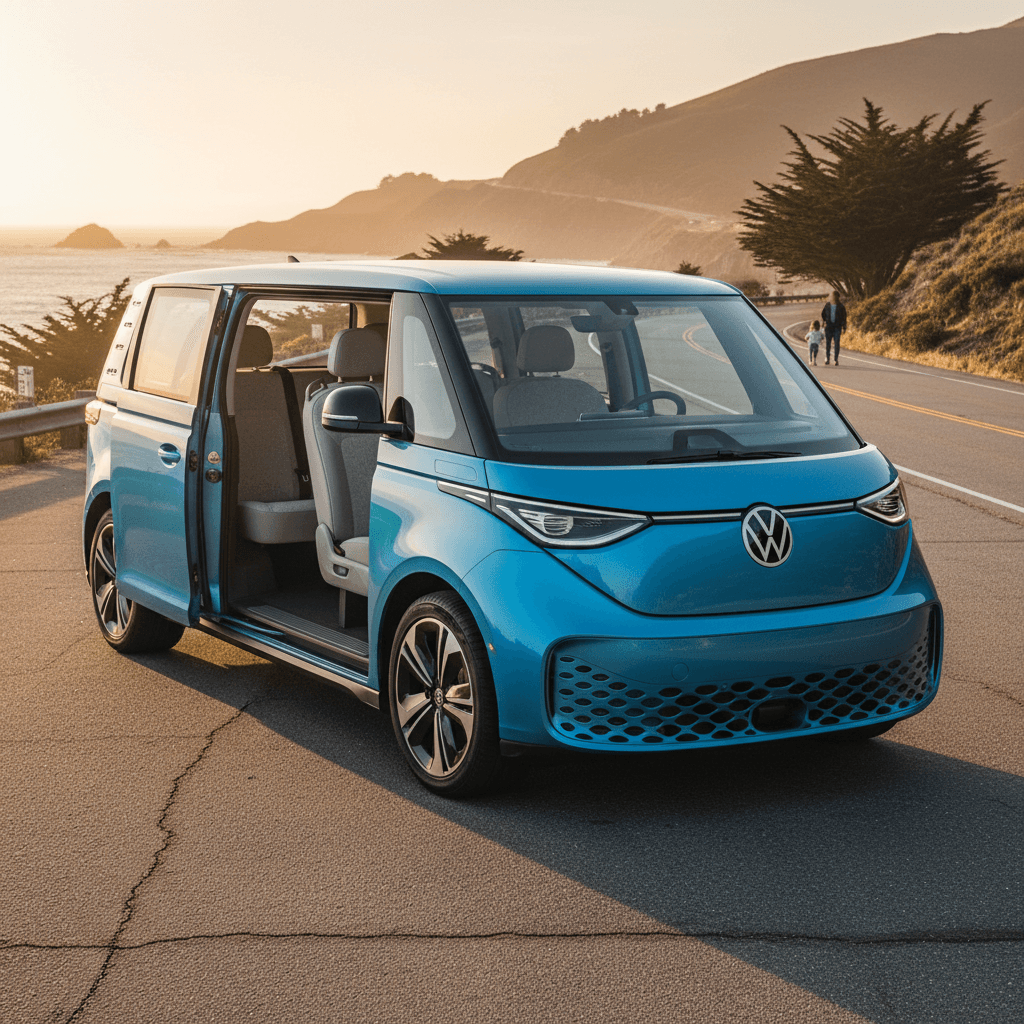
If you’ve ever stared at photos of classic VW buses and thought, “Why can’t someone build that again, but electric and safe enough for my kids?” the 2024 Volkswagen ID. Buzz is your answer. After years of concepts and delays, the retro-styled electric microbus has finally made it to U.S. shores as a long-wheelbase, 3-row people mover, and it’s already one of the most talked‑about EVs on the road.
Quick take
Overview: ID. Buzz Comes to America (At Last)
The U.S.-spec ID. Buzz is based on VW’s MEB electric platform, stretched into a long‑wheelbase body with three rows of seats. Europe gets a shorter 2‑row version, but here you only see the big, 3‑row van, think modern microbus meets family shuttle. For most shoppers in 2024 and 2025, you’ll be cross‑shopping it not against other vans, but against 3‑row EV SUVs like the Kia EV9 or large gasoline minivans.
VW ID. Buzz Key Numbers (U.S. Long-Wheelbase)
On paper, that makes the ID. Buzz a spacious, reasonably powerful EV people‑mover with honest, if not spectacular, range. In practice, it’s a rolling conversation starter that drives more like a big, comfy wagon than a traditional minivan.
Model-year timing note
Powertrain, Range and Charging Performance
Motors, power and performance
Every ID. Buzz in the U.S. uses a 91 kWh battery pack and offers two powertrain layouts:
- Single‑motor rear‑wheel drive: 282 hp, smooth and relaxed rather than neck‑snapping quick.
- Dual‑motor 4MOTION all‑wheel drive: 335 hp, noticeably brisker off the line and more confidence‑inspiring in bad weather.
VW hasn’t made the Buzz a drag‑strip hero, and that’s fine. It feels more akin to a strong V6 minivan than a performance EV. Around town, torque comes in smoothly and it’s easy to keep up with traffic even when fully loaded with people and gear.
Range: enough for families, not for range chasers
Officially, you’re looking at roughly 231–234 miles of EPA-estimated range, depending on rear‑drive or AWD. That’s perfectly usable for everyday commuting, kid‑shuttling and weekend getaways, but it doesn’t rewrite the rulebook the way some 300‑mile EV SUVs do.
Real‑world range feels better than the sticker
If you live in a colder climate or plan to tow, you’ll want to mentally budget some range loss, just as you would with any EV. The Buzz isn’t unusually fragile here; it’s just a big, blunt‑faced box pushing air out of the way.
Charging: fast enough to road‑trip
On the charging side, Volkswagen got the basics right:
- DC fast charging up to around 200 kW, good for a 10–80% fill in roughly 25–30 minutes under ideal conditions.
- AC home charging up to 11 kW on a 240‑volt Level 2 setup, which means an overnight charge from empty is no big deal.
- Battery pre‑conditioning tied to navigation, so the pack can warm itself before a planned fast‑charge stop to hit those higher speeds more consistently.
Charging at home
Interior Space, 3 Rows and Everyday Practicality

Where the ID. Buzz really earns its keep is inside. The long wheelbase, nearly vertical tailgate and sliding rear doors make it feel more like a friendly living room on wheels than a conventional crossover.
Seating comfort and configuration
- Front seats are generously padded with available heating, ventilation and even massage on higher trims.
- Second‑row bench is split 60/40 and slides, reclines and folds, with dual power‑sliding side doors making access easy.
- Third row is a 50/50 split bench that can fold or be removed entirely, each section weighing roughly 30 pounds so you can muscle it out for a big‑cargo weekend.
Third‑row safety recall
Head‑ and legroom are excellent in the first two rows. Adults can ride in the third row for shorter trips, but tall passengers may brush the headliner. In other words, it behaves like most three‑row vehicles, just with much more character.
Cargo space and usability
With all three rows up, you get a useful but not cavernous cargo area, perfect for a grocery run or a weekend’s worth of soft bags. Fold the third row or pop it out and the ID. Buzz turns into a small moving van. The floor is long, flat and square, which is exactly what you want for camping gear, strollers or the occasional IKEA binge.
Road‑trip hack
Tech, Infotainment and Driver Assistance
If you’re familiar with other recent VW EVs, the Buzz’s tech will feel similar, though VW has been gradually improving software and controls after early criticism.
Screens and infotainment
- A central touchscreen (over 12 inches on most trims) handles navigation, media and climate.
- A compact digital cluster ahead of the driver keeps speed, range and key info easy to read.
- Wireless Apple CarPlay and Android Auto are widely available, plus multiple USB‑C ports spread through the cabin.
Earlier VW ID models were dinged for laggy touch controls and confusing menus. In the Buzz, the system is better but still not class‑leading. Expect a learning curve, and know that some frequently used functions still hide behind touchscreen layers instead of physical buttons.
IQ.Drive safety and driver assistance
Every U.S. ID. Buzz comes with VW’s IQ.Drive suite of driver‑assistance tech. Depending on trim, you’ll see features such as:
- Travel Assist: combines adaptive cruise control with lane‑centering on the highway.
- Front Assist: automatic emergency braking with pedestrian and cyclist detection.
- Side Assist: blind‑spot monitoring with rear cross‑traffic alert.
- Dynamic Road Sign Display: reads speed limit and other signs to keep you informed.
- Park Distance Control and available Park Assist with a memory function that can repeat tricky parking maneuvers for you.
Driver‑assist is not self‑driving
On-the-Road Driving Impressions
A big part of the ID. Buzz’s appeal is emotional. You see it, you smile. Fortunately, the way it drives mostly backs up those good vibes.
- Steering is light but accurate, which makes city driving and parking feel less daunting than you’d expect for a vehicle this boxy.
- Ride quality skews soft and comfortable, especially on the smaller wheel options, soaking up rough pavement and expansion joints.
- Wind and road noise are well controlled for something shaped like a loaf of bread, though you’ll hear more whoosh at highway speeds than in a slippery SUV.
- The turning circle is impressively tight, a reminder that underneath the cosplay bus styling is a modern EV platform with wheels pushed far to the corners.
The intangible factor
Pricing, Trims and Overall Value
Here’s where the nostalgia tax comes in. For the 2025 model year (built from the 2024 engineering program), U.S. pricing looks roughly like this, including destination but before any discounts:
2025 VW ID. Buzz U.S. Pricing Snapshot
Representative pricing for the long‑wheelbase ID. Buzz in the United States.
| Trim | Drivetrain | Approx. MSRP | What You Get |
|---|---|---|---|
| Pro S | RWD | ≈ $61,500 | Well‑equipped base with 7 seats, big screen, IQ.Drive. |
| Pro S Plus | RWD | ≈ $65,000 | Adds upgraded interior trims, glass roof, more comfort features. |
| 1st Edition | RWD | ≈ $67,000 | Launch special with unique styling and most options bundled in. |
| Pro S Plus 4MOTION | AWD | ≈ $69,500 | Extra power and all‑weather traction. |
| 1st Edition 4MOTION | AWD | ≈ $71,500 | Top dog with AWD and launch‑edition details. |
Actual transaction prices can be several thousand dollars below MSRP depending on trim, availability and incentives.
Discounts and incentives
The hard truth: for many families, a Kia EV9 or even a plug‑in‑hybrid Chrysler Pacifica will deliver similar practicality and range for less money. With the Buzz, you’re paying partly for design, heritage and that “I finally got my electric bus” feeling.
VW ID. Buzz vs. Kia EV9 and Other EV Alternatives
Kia EV9 & 3‑Row EV SUVs
- Pros: Typically more range, lower starting prices, more traditional SUV driving position.
- Cons: Less cargo volume with seats removed, not as much personality, no sliding doors.
- Best for: Families who want maximum range per dollar and a familiar SUV experience.
VW ID. Buzz
- Pros: Huge, square cargo space; sliding doors; removable third row; iconic styling.
- Cons: Higher price, mid‑pack range, extra wind noise at speed.
- Best for: Road‑trip dreamers, camping families, design‑driven buyers who want something different.
If you strip away the nostalgia, the Buzz isn’t the rational choice on a spreadsheet. But cars aren’t spreadsheets. If the idea of an electric microbus has lived rent‑free in your head for decades, a slightly cheaper SUV may feel like the wrong kind of compromise.
Ownership, Charging and Living With an ID. Buzz
What It’s Like to Live With an ID. Buzz
From home charging to long‑haul road trips, here’s what to expect.
Daily driving
The Buzz excels as a school‑run and commute companion. Easy step‑in height, big windows and simple controls make it friendly even for drivers who are new to EVs.
Charging routine
With 230‑ish miles of rated range, most owners will plug in at home a few nights a week instead of every day. A 40–60% daily SOC window works nicely.
Road‑trip behavior
Fast‑charging at up to 200 kW means a coffee‑and‑bathroom stop can add serious miles, but you’ll plan your route around DC fast chargers more carefully than you would in a 300‑mile EV.
Plan your charging network
If you’re cross‑shopping multiple used EVs, this is exactly the kind of planning Recharged’s EV‑specialist team walks through with shoppers. It’s not just, “What’s the EPA number?” It’s, “How does this vehicle’s battery, charging curve and cabin space fit your actual life?”
Buying a Used ID. Buzz: What to Watch For
Because U.S. deliveries began in earnest for the 2025 model year, early ID. Buzz vans will start appearing on the used market surprisingly quickly, especially given the premium pricing and mid‑pack range. That’s good news if you love the idea but not the MSRP.
Used ID. Buzz Inspection Checklist
1. Confirm recall work
Verify that the third‑row seatbelt/bench‑width recall and any other safety campaigns have been completed. Ask for documentation or check the VIN against NHTSA’s database.
2. Check battery health
Use a detailed battery health report, like the <strong>Recharged Score</strong>, to see how the pack has fared. Frequent DC fast charging or hot‑climate use doesn’t automatically mean trouble, but it’s important context.
3. Inspect tires and brakes
The Buzz is heavy and torquey. Uneven tire wear or noisy brakes can hint at aggressive driving or alignment issues. Budget for high‑quality replacements if they’re near the end of life.
4. Test all sliding doors and seats
Cycle power sliding doors, fold and slide all seats, and remove the third row if possible. A van lives and dies by its usability; sticky latches will drive you nuts later.
5. Evaluate software and infotainment
Make sure the infotainment is on current software, that the system boots quickly and that common functions (climate, drive modes, camera views) are easy enough to access.
6. Look for water and odor issues
With big openings and lots of seals, you want to be confident there are no leaks. Smell for mildew, check for damp carpet and inspect weatherstripping around doors and tailgate.
Why a Recharged Score matters on an ID. Buzz
Ready to find your next EV?
Browse VehiclesFAQ: 2024 VW ID. Buzz
Frequently Asked Questions About the VW ID. Buzz
Bottom Line: Who the ID. Buzz Is Really For
The 2024 VW ID. Buzz (and its early‑run 2025 U.S. sibling) is not the rational choice for every family. It’s pricey, its range is solid but not spectacular, and you can absolutely find more metal for your money elsewhere. But if you’ve always wanted an electric microbus, a vehicle that turns every Target run into a tiny road trip, this is the one you’ve been waiting on for decades.
For shoppers who prioritize character, space and comfort over spec‑sheet bragging rights, the Buzz makes a compelling case. And if you’re eyeing one on the used market in a year or two, partnering with Recharged for battery health diagnostics, fair‑market pricing and EV‑savvy guidance can turn a nostalgic dream into a smart purchase.