If you’re drawn to the retro charm of the 2024 Volkswagen ID. Buzz, you’re not alone. But before you put one in the driveway, especially as a used EV, you probably want to know how the 2024 VW ID Buzz reliability story is shaping up. The short answer: it’s not a disaster, but it’s also not a slam-dunk, and context really matters.
Quick take
2024 VW ID. Buzz reliability in a nutshell
Early reliability snapshot: 2024–2025 VW ID. Buzz
If you’re comparing the ID. Buzz to a Toyota Sienna or Honda Odyssey, it’s not yet in that "buy it and forget it" league. But compared with many first‑wave EVs, Volkswagen has avoided the most frightening failure modes so far: widespread battery defects, drive unit failures, or chronic high‑voltage fires. Most of the noise around the Buzz has been about recalls, software quirks, and market mis‑steps (price, range, timing) rather than constant breakdowns.
Big picture warning
How “new” is too new? Why 2024 reliability data is still thin
The ID. Buzz reached U.S. buyers in late 2024, after launching in Europe earlier. That means there simply hasn’t been enough time or mileage yet to build a rock‑solid reliability record, especially in North America, where only a few thousand vans are on the road.
- Most U.S. 2024 ID. Buzz vans are still under 20,000 miles of use.
- The platform shares components with other VW ID models, but packaging and software are unique.
- Small production volume means any single owner’s bad experience is amplified online.
- VW is still issuing software updates and rolling fixes as real‑world data comes in.
What that means for you
Known 2024–2025 VW ID. Buzz recalls and issues so far
The early recall story for the ID. Buzz is unusual more than catastrophic. You’re not looking at exploding batteries, but there are a couple of important safety‑related campaigns to confirm on any 2024 or 2025 van you’re considering.
Key ID. Buzz recalls affecting 2024–2025 U.S. vans
Always run a VIN check to verify recall completion before you buy.
| Issue | Model years / build dates | What’s wrong | How it’s fixed | Reliability impact |
|---|---|---|---|---|
| Third-row bench too wide | Primarily 2025 U.S. vans; design present on 2024 build spec | Rear bench seat was wide enough to suggest 3 passengers, but only 2 seatbelts were fitted, violating crash‑protection rules. | Dealers install fixed trim pieces to narrow the usable width so no one can ride unbelted in a pseudo‑middle spot. | Low direct reliability impact once fixed; it’s a safety compliance issue, not a mechanical weakness. |
| Brake warning light symbol/color | Vans built roughly Sept 2024–Feb 2025 | Brake system warning indicator used the wrong symbol/color versus U.S. regulations. | Dealers perform a software update and data container update, typically in a single day. | No change to braking hardware; again, it’s about compliance and correct driver information. |
| Stop‑sale while fixing both recalls | Early 2025 | VW temporarily halted U.S. sales while it processed fixes on in‑stock and customer vehicles. | Once updates and trim parts were available, dealers resumed deliveries. | The stop‑sale created backlog and frustrations but doesn’t inherently make a fixed van less reliable. |
Recall coverage and completed repairs matter more than the fact that a recall happened at all.
Don’t skip this step
ID. Buzz battery life and range reliability
When people ask about "2024 VW ID Buzz reliability," what they’re often really worried about is the battery. Will it hold up, or will range collapse after a few years? So far, Volkswagen’s track record with its 77 kWh battery pack in other ID‑series vehicles is encouraging.
What we know from VW’s other EVs
- The ID. Buzz uses a similar VW MEB platform and battery technology to the ID.4 and ID.3.
- Real‑world data from those vehicles suggests slow, predictable battery degradation when used normally.
- VW backs the high‑voltage battery for 8 years/100,000 miles (whichever comes first) against dropping below 70% of original capacity.
- Most early ID. Buzz vans are far from that threshold; you’re more likely to see minor range loss from weather and driving style than from aging alone.
Range "reliability" is a softer topic. The Buzz’s 231–234‑mile EPA estimates are modest for such a big, boxy vehicle, and highway or cold‑weather driving can chip away at that quickly. That’s not a failure, it’s physics, but it does mean you should plan around frequent DC fast‑charging on road trips.
Battery health tip for used shoppers
What early owners are reporting about reliability
Owner feedback on the ID. Buzz so far is scattered, partly because there aren’t many vans in circulation, and partly because expectations were sky‑high. You’ll see glowing five‑star reviews right next to one‑star rants, sometimes for the exact same vehicle.
Early owner experiences: the good, the bad, and the weird
Pulling patterns out of a small, very vocal sample size.
The good
Plenty of owners report zero major issues in the first several months and thousands of miles.
- Quiet, smooth drivetrain
- Lots of space and family‑friendly features
- Strong satisfaction from buyers who wanted a fun, characterful EV people‑mover
The bad
Several reports mention nuisance problems more than catastrophic failures:
- Warning lights or sensors needing resets
- Dealer techs still getting up to speed on diagnostics
- Minor electronic gremlins that resolve with software updates
The frustrating
The most consistent complaint isn’t what breaks, it’s how long it can take to fix:
- Waits for parts unique to the Buzz
- Limited number of EV‑trained techs at VW dealers
- Vans sometimes sitting for days or weeks for simple issues
Service bottlenecks matter
How the ID. Buzz compares to other electric vans and 3-row EVs
There still aren’t many true electric vans in the U.S., so buyers often cross‑shop the ID. Buzz against 3‑row electric SUVs and plug‑in hybrid minivans. Reliability‑wise, it currently sits in the middle of the pack.
Versus other VW EVs (ID.4, ID.3)
- Shares core battery and motor tech with the wider ID family.
- That’s good news for battery durability, which has tested well in long‑term evaluations.
- But software and packaging differences mean some Buzz‑specific glitches are to be expected.
Versus other 3-row EVs
- Some competitors (especially from Korean brands) have cleaner early software records but similar growing pains.
- Traditional minivans still hold the crown for proven, low‑drama reliability.
- The Buzz trades some bulletproof dependability for style, electric torque, and novelty.
Where the ID. Buzz fits on a simple reliability spectrum
Every vehicle lives somewhere between "appliance" and "science project."
| Vehicle type | Typical reliability feel (early years) | Biggest risk |
|---|---|---|
| Traditional minivan (gas) | Boringly dependable once known issues are addressed | Wear items and normal aging |
| Mainstream 3-row EV SUV | Mostly solid with some infotainment/charging quirks | Software updates, early‑build bugs |
| 2024–2025 VW ID. Buzz | Charming but still maturing, quirks, recalls, and service delays to watch | Dealer competence, parts wait times, limited real‑world history |
This is directional, not a scientific scoring, use it as a conversation starter, not a verdict.
VW ID. Buzz warranty coverage and what it really means
Volkswagen backs the ID. Buzz with warranty coverage broadly in line with other modern EVs. Understanding what’s actually covered, and what isn’t, goes a long way toward answering the reliability question.
- Bumper‑to‑bumper warranty: typically 4 years/50,000 miles (check the exact terms on your year and trim).
- High‑voltage battery warranty: 8 years/100,000 miles against capacity dropping below 70%.
- Corrosion and roadside assistance: additional coverage usually included for a set number of years.
How to make the most of the warranty
Buying a used 2024 VW ID. Buzz: reliability checklist
Because the ID. Buzz is expensive new and already facing slow U.S. sales, a lot of shoppers are eyeing lightly used 2024 vans as soon as they hit the market. If that’s you, don’t let the nostalgia goggles do all the driving.
Used 2024 VW ID. Buzz reliability checklist
1. Confirm all recalls are completed
Ask for documentation showing the third‑row seat and brake‑warning‑light recalls are done. Cross‑check the VIN with a VW dealer or an online recall lookup before you sign anything.
2. Get objective battery health data
Range readouts are useful, but a <strong>proper battery health scan</strong> is better. Vehicles purchased through Recharged include a Recharged Score battery report, so you know how much usable capacity remains and how the pack has been treated.
3. Review software and update history
Ask which software version the van is running and whether updates have been done at the dealer. Frequent, incomplete updates can be a red flag; a van that’s current and stable is what you want.
4. Inspect for water leaks and trim issues
Like any tall, boxy vehicle with big openings, the Buzz can suffer from wind noise or water intrusion if doors and seals aren’t perfect. Look for moisture in the cabin, stained headliners, or uneven door gaps.
5. Test all doors, seats, and child‑friendly features
This is a family vehicle, slide the doors repeatedly, fold the seats, check all seatbelts and latches. A sticky sliding door is annoying; a reluctant seatbelt in the third row is a deal‑breaker.
6. Ask about downtime and prior repairs
"Has this van ever spent more than a week at the dealer?" is a great question. Long stays for simple issues may hint at dealer limitations or a problem child you don’t want to adopt.
How Recharged can help
Ready to find your next EV?
Browse Vehicles
Cost of ownership, downtime, and parts availability
Even if your ID. Buzz never leaves you stranded, there are a few ownership realities that tie directly into how "reliable" it will feel in your daily life.
Reliability isn’t just about breakdowns
Three factors that shape day‑to‑day ownership of a 2024 ID. Buzz.
Parts pricing
The Buzz is built in Europe and sold in relatively low volume in North America. That can mean higher parts prices and fewer aftermarket alternatives, for now.
Parts availability
Early owners have already run into waits for modules, trim, and unique Buzz components. A small hiccup can become a long wait if the part has to cross an ocean.
Technician experience
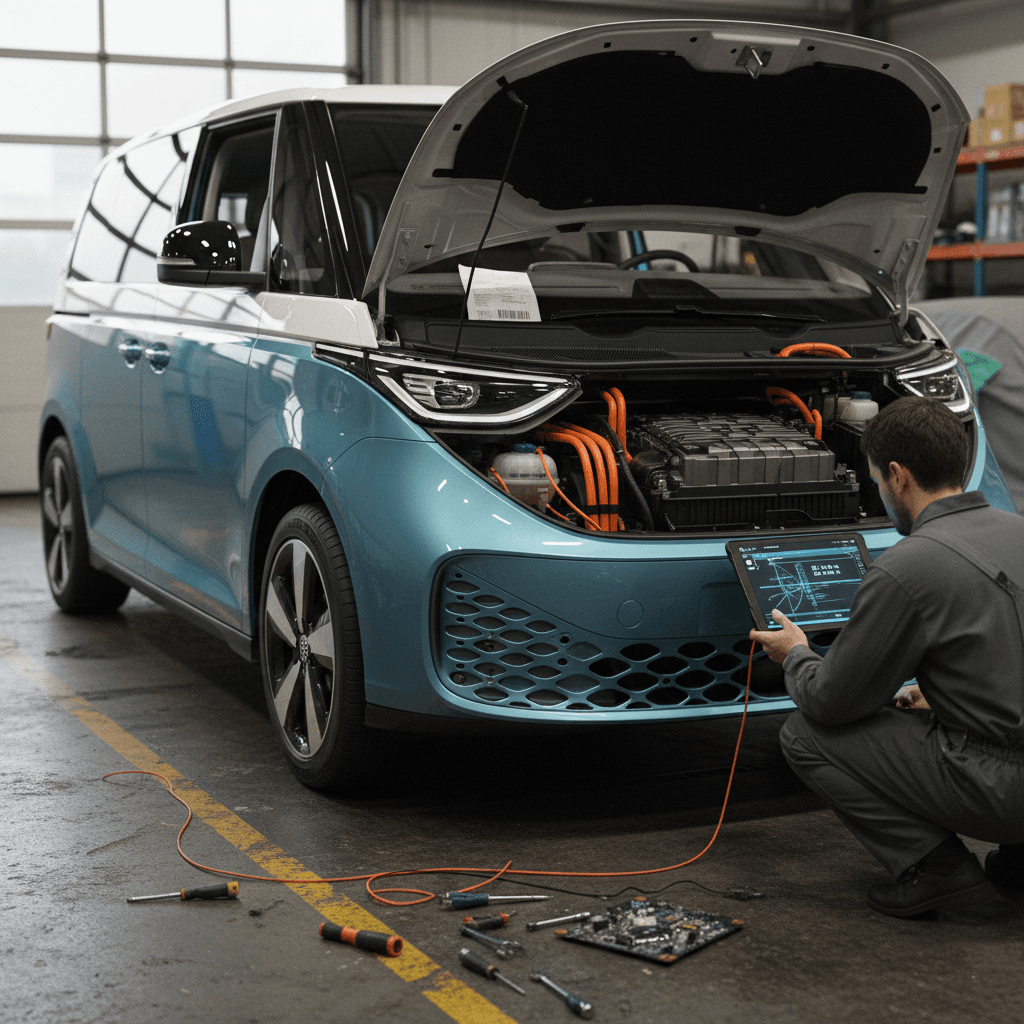
Volkswagen dealers are still ramping up their EV technician base. Not every store has a Buzz expert yet, so diagnosis can take longer than you’d expect on a simple gas minivan.
Plan for a backup plan
So… is the 2024 VW ID. Buzz a reliable buy?
The 2024 VW ID. Buzz is not a disaster, and it’s not yet a proven workhorse. It’s a first‑generation, low‑volume EV from a mainstream brand that’s still learning how to serve American EV buyers. Mechanically, its simple electric drivetrain and well‑proven battery chemistry are promising. On the other hand, early recalls, software quirks, and dealership growing pains mean you should expect more surprises than you’d get from a traditional minivan.
If you love the look, understand the range, and can live with the possibility of extra dealer visits in the first few years, a properly sorted 2024 ID. Buzz, especially one with a clean recall history and strong battery health, can be a satisfying family EV. If your top priorities are maximum uptime and minimal drama, a more established 3‑row EV or a conventional hybrid minivan will still feel more "set it and forget it" reliable.
Whichever way you lean, going in with clear expectations is the real reliability advantage. Tools like the Recharged Score report, transparent battery diagnostics, and EV‑savvy guidance turn a nostalgic impulse buy into a smart, data‑backed decision.