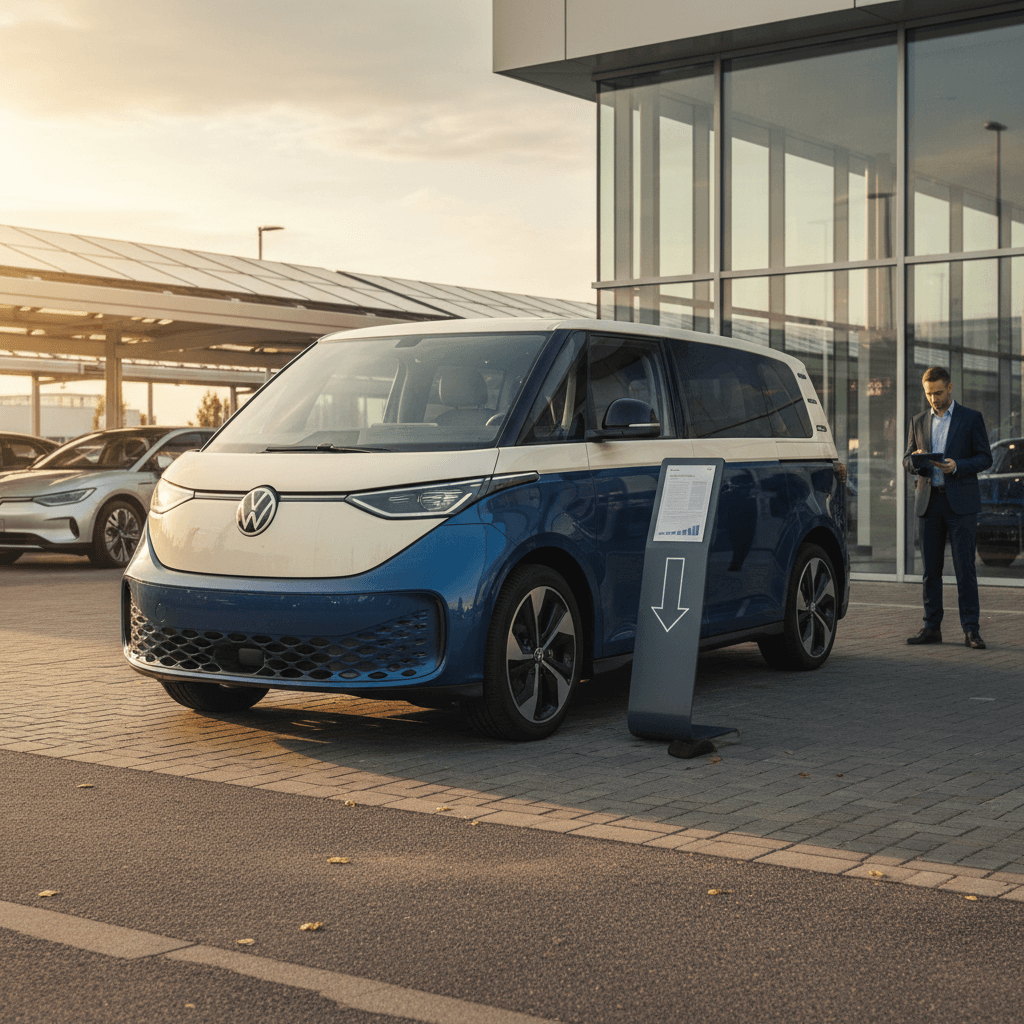
If you bought a 2024 Volkswagen ID. Buzz, you’ve probably already noticed a hard truth: the market cooled off faster than VW expected, but sticker prices didn’t. By early 2026, dealer incentives, a skipped 2026 model year, and average range have all started to drag on 2024 Volkswagen ID. Buzz trade in value, and owners are feeling the hit when they get appraisals.
Snapshot: 2024 ID. Buzz values in early 2026
2024 ID. Buzz trade-in basics in 2026
The 2024–2025 long‑wheelbase ID. Buzz finally landed in the U.S. with huge buzz (no pun intended), MSRPs clustered around low $60,000s to low $70,000s, and, at first, some hefty dealer markups. As reality set in, slow sales, aggressive discounts, and VW’s decision to skip the 2026 U.S. model year and re‑launch for 2027 created a perfect storm for early depreciation.
Early market signals for VW ID. Buzz value
That doesn’t mean your van is doomed to be a depreciation disaster. But it does mean you can’t just plug your VIN into a generic ICE trade-in tool and expect it to understand the nuances of a niche three‑row EV that launched at the wrong time in the EV cycle.
What is a 2024 Volkswagen ID. Buzz worth right now?
No article can tell you what your exact van is worth to the dollar, that depends on your mileage, options, and local demand. But based on current U.S. dealer asking prices and used‑EV appraisal tools, it’s possible to outline realistic 2024 Volkswagen ID. Buzz trade in value ranges in early 2026.
Approximate 2024 ID. Buzz value bands in early 2026
These rough ranges assume a clean history, no significant damage, and typical annual mileage for a family vehicle (10,000–15,000 miles per year).
| Vehicle condition & scenario | Typical miles | Likely trade-in range | Likely private-party range |
|---|---|---|---|
| Near-new, loaded First Edition bought at MSRP | 5,000–12,000 | $50,000–$56,000 | $54,000–$60,000 |
| Well‑optioned Pro S / Pro S Plus, no prior accidents | 15,000–25,000 | $46,000–$52,000 | $50,000–$56,000 |
| Higher miles (30k+), or minor cosmetic issues | 30,000–40,000 | $42,000–$48,000 | $45,000–$52,000 |
| Prior accident on record, visible wear, or stale color/trim | Any | $38,000–$45,000 | $42,000–$48,000 |
Actual offers will depend heavily on region, trim, incentives at time of purchase, and how badly a given dealer wants an ID. Buzz on their lot.
Beware of fantasy pricing
For context, mainstream depreciation tools already project that an ID. Buzz could lose roughly half of its original value over five years of ownership if current market conditions persist. That’s aggressive, but not unheard of in today’s EV market, especially for high‑priced models with only average range.
Why 2024 ID. Buzz trade-in values are slipping faster than you expect
From 30,000 feet, the ID. Buzz looks like it should be a resale rock star: a nostalgic design, lots of space, and limited supply. But used‑market values are shaped less by vibes and more by cold math. Here are the big forces pulling on your 2024 ID. Buzz trade-in number in 2026.
Four big forces shaping 2024 ID. Buzz trade-in value
It’s not just about what you paid, it’s about how the whole EV market has moved since then.
1. High price, average range
The ID. Buzz launched at a price level shoppers associate with luxury SUVs, but with roughly 230–234 miles of EPA range. In 2026, that’s acceptable but not compelling for a $70k family hauler, and appraisers price that in.
2. EV market cooling cycle
After the 2021–2023 EV boom, higher interest rates and more competition pushed down new and used EV prices. Vans and large crossovers with modest range feel this most.
3. 2026 model-year pause
VW’s decision to skip the 2026 U.S. model year and come back with a refreshed 2027 Buzz makes today’s vans feel like "early build" experiments. That uncertainty nudges trade values lower.
4. Incentives & markups whiplash
Many early buyers paid markups or saw prices fall shortly after purchase. When the new‑car side is blowing out remaining stock with deep discounts, used values inevitably follow.
How this compares to other EVs
8 factors that move your ID. Buzz trade-in number up or down
Once you zoom in from the market‑wide picture, your personal van’s value comes down to a handful of concrete things. The good news: you control several of them.
Key value drivers for a 2024 Volkswagen ID. Buzz
1. Mileage vs. age
A 2024 ID. Buzz with under 15,000 miles will generally appraise several thousand dollars higher than one with 30,000+ miles, especially on trade, where dealers look hard at how quickly they can retail it.
2. Battery health & fast‑charge history
Even though ID. Buzz packs are holding up reasonably well in early data, any evidence of reduced usable range or heavy DC fast‑charging can spook buyers. Platforms like Recharged use <strong>pack‑level diagnostics</strong> to score actual health instead of guessing.
3. Accident and repair history
A clean history report is table stakes. Even a well‑repaired minor accident can knock $1,000–$3,000 off trade value; major structural or airbag deployments hit harder and can push some buyers out entirely.
4. Trim, options, and color
Desirable specs, AWD, popular colors, full‑length glass roof, can keep your Buzz closer to the top of its value band. Odd color combos or sparse spec on a halo vehicle hurt demand.
5. Interior wear and tear
Family vans live hard lives. Deep stains, damaged seatbacks, broken trim, and hacked‑in accessories all cost money to recondition. Dealers subtract that from your offer; private buyers use it to negotiate.
6. Tires and brakes
A nearly new set of EV‑rated tires and solid brake life make your van easier to retail. Bald or mismatched tires can shave another $800–$1,500 off a trade, because the buyer will expect fresh rubber on a $50,000+ used EV.
7. Software and recall status
Up‑to‑date software, completed recalls, and no active warning lights signal an owner who stayed on top of issues. Unresolved recalls or error messages raise reconditioning risk and push offers down.
8. Local demand for big EVs
ID. Buzz demand isn’t uniform. Coastal urban markets and EV‑dense suburbs may pay more for a quirky electric van than inland regions where charging is sparse and buyers default to ICE minivans.
How dealers actually appraise a 2024 ID. Buzz
When you pull into a dealer with an ID. Buzz, especially one that hasn’t sold many, what happens behind the scenes is surprisingly formulaic. Understanding that process helps you separate a fair offer from a lowball.
Step 1: Pull the data
Most appraisers start by checking:
- Recent auction results for similar ID. Buzzes
- Asking prices for comparable vans within a few hundred miles
- Third‑party trade-in guides for a baseline number
With a niche EV like the Buzz, there often isn’t much data, so they lean extra hard on conservative assumptions.
Step 2: Inspect and adjust
Then they:
- Walk the exterior for paintwork, dings, and glass damage
- Scan the interior for odors, wear, and missing items
- Check tires, brakes, and test‑drive for noises
- Run a history report and look for open recalls
Each issue gets turned into an estimated reconditioning cost, which is subtracted from the initial value estimate.
Finally, the used‑car manager decides how much risk they want to take on a $50,000‑plus electric van in a softening EV market. Two different dealers can easily be $3,000–$5,000 apart on the same 2024 ID. Buzz, purely based on appetite and how similar vehicles have sold for them recently.
Leverage multiple EV‑savvy appraisals
6 ways to boost your 2024 ID. Buzz trade-in value
You can’t rewrite the market, but you can absolutely tighten the range between “worst‑case” and “best‑case” offers for your specific van. Think like an appraiser: your job is to make their risk feel smaller.
- Detail it like you’re selling it yourself: A professional interior and exterior detail, including steam‑cleaned fabric and ozone treatment if needed, is cheap compared with the $500–$1,000 deduction dealers routinely take for dirty vans.
- Fix obvious, low‑cost issues first: Replace broken trim pieces, missing floor mats, dead key‑fob batteries, and chipped windshield glass if your insurance covers it.
- Put fresh, matching EV‑rated tires on if you’re nearly due: On a heavy, torque‑rich EV van, mismatched or worn tires are a red flag. A new set can more than pay for itself in higher offers.
- Gather both keys, manuals, and charging equipment: Missing keys or the original Level 1/Level 2 charging cable will trigger deductions and annoying delays. Present everything neatly at appraisal.
- Document software updates and service: A simple folder or PDF printout showing recall completion, software updates, and routine service reassures the buyer that you weren’t ignoring warning lights.
- Get a battery health report: If you can document that your pack still has strong usable capacity, you turn an unknown into a selling point, especially with EV‑savvy buyers. Recharged builds this into our Recharged Score report.
Where Recharged fits in
Ready to find your next EV?
Browse VehiclesTrade-in vs. private sale vs. EV marketplace: What nets the most for an ID. Buzz?
With a mainstream compact SUV, the decision is pretty straightforward: trade‑in for convenience, private sale for money. With a quirky $60,000–$70,000 electric van, the equation changes. Not every private buyer is ready to wire that kind of money for an EV they barely understand.
Ways to sell a 2024 VW ID. Buzz: Pros, cons, and typical returns
How different selling channels usually stack up for a high‑priced niche EV like the ID. Buzz.
| Channel | Typical pricing vs. trade | Effort level | Best for |
|---|---|---|---|
| Dealer trade-in | Baseline | Lowest | Speed, sales‑tax savings, and minimal hassle |
| “Instant cash” online buyer | ≈ +$500–$1,500 | Low | When local dealers are clearly under‑bidding |
| EV‑focused marketplace (e.g., Recharged) | ≈ +$2,000–$5,000 | Medium | Maximizing value with expert help and wide buyer reach |
| DIY private sale | ≈ +$3,000–$6,000 | High | Experienced sellers in EV‑dense markets who can wait for the right buyer |
Exact numbers vary by region and timing; think of these as directional ranges, not guarantees.
The risk of going it alone
Recharged sits in the middle: you get expert EV pricing, a battery health report, financing for your buyer, and nationwide reach, without being the one who has to answer every “Can I camp in it?” text at midnight.
Is now the right time to trade your 2024 ID. Buzz?
The toughest part of selling any new‑ish EV right now is the sense that values might fall further. With the ID. Buzz, that’s not just paranoia, there are real reasons to think timing matters.
Holding vs. selling your 2024 ID. Buzz in 2026
How today’s decisions play against tomorrow’s updates.
Why you might sell sooner
- You bought at or near peak pricing or with a markup, and values have already dropped.
- You don’t use all the space or features and could live with a smaller, more efficient EV.
- You want out before the refreshed 2027 Buzz arrives and resets expectations on range and tech.
Why you might hold longer
- You love the van and plan to drive it well past the warranty window.
- Your payment works, and you’re not upside‑down on the loan.
- You live in a market where ID. Buzz supply is genuinely tight and values feel more stable.
Watch the 2027 announcement closely
If you already know the ID. Buzz isn’t the right long‑term fit, dragging your feet rarely helps in a market where new EV prices are drifting down. The bigger question is how you exit: quickly via trade, or more deliberately through a specialist channel.
How Recharged estimates VW ID. Buzz value and battery health
Most generic appraisal tools were built around gasoline crossovers and minivans. They struggle with questions that matter for EV vans: How healthy is the pack? How does real‑world range compare to when it was new? How do we factor in that 2026 gap year and a coming 2027 refresh?
The Recharged Score advantage
Every vehicle on Recharged gets a Recharged Score Report that includes:
- Battery health diagnostics based on pack data, not just odometer readings
- Charging behavior insights (home vs. DC fast‑charging mix)
- Condition grading with photos and technician notes
- Fair‑market pricing benchmarks from EV‑specific data
Built for EV shoppers and sellers
Because Recharged is focused on used EVs, not everything under the sun, we can:
- Spot realistic outliers (good and bad) on ID. Buzz values
- Explain depreciation dynamics to buyers so they don’t over‑discount your van
- Offer financing, trade‑in, and nationwide delivery to expand your buyer pool
If you’re in or near Virginia, you can even visit our Experience Center in Richmond to talk through options in person.
Considering a swap into a different EV?
FAQ: 2024 Volkswagen ID. Buzz trade-in value
Frequently asked questions about 2024 ID. Buzz trade-in values
The 2024 Volkswagen ID. Buzz was always going to be a heart‑over‑head purchase. In today’s market, that means trade‑in values can feel harsh compared with what you paid just a year or two ago. The smartest play is to confront that reality with clear data: what your van is worth in your region today, how healthy its battery really is, and which selling channel will leave you with the most money and the least regret. If you decide it’s time to move on, an EV‑specialist platform like Recharged can turn a confusing, one‑sided negotiation into a transparent, battery‑first conversation, so your Buzz’s value reflects more than just a guess at what’s happening under the floor.