If you’re shopping for a 2024 Rivian R1T, you’re looking at one of the most interesting vehicles on the market: an all‑electric pickup that can outrun a sports car, tow like a half‑ton truck, and tackle trails most SUVs won’t touch. But Rivian has tweaked trims, motors, and battery packs enough that choosing the right R1T, and deciding whether to buy new or used, takes a bit of homework.
Where the 2024 R1T fits in the lineup
Why the 2024 R1T Is a Special Case
Rivian is still a young brand, so each model year feels more like a major software update than a subtle refresh. The 2024 R1T benefits from earlier fixes to suspension hardware, software stability, and charging behavior, yet it’s early enough in the truck’s life that many examples are still under comprehensive warranty and have relatively low mileage.
2024 Rivian R1T market snapshot (United States)
Mind the configuration details
2024 Rivian R1T trims, motors, and battery packs
Rivian moved away from traditional trim names (like “LT” or “Lariat”) and instead organizes the R1T around motor and battery combinations. For 2024 you’ll most commonly see Dual‑Motor and Performance Dual‑Motor trucks, with a smaller number of Quad‑Motor models still around, usually from earlier orders that delivered into the 2024 calendar year.
2024 R1T motor options at a glance
Power and traction are standard; how wild you go is up to you.
Dual‑Motor AWD
Best for: Value and range.
- Approx. 533 hp with strong everyday performance.
- Standard on most 2024 R1Ts.
- Pairs with Standard, Large, or Max battery packs (availability varies by build).
Performance Dual‑Motor AWD
Best for: Maximum punch per dollar.
- Software‑enabled boost over the base dual‑motor.
- 0–60 mph in the mid‑3‑second range.
- Often bundled with larger wheels and sportier tires.
Quad‑Motor AWD (earlier builds)
Best for: Off‑road grip and bragging rights.
- Individual motor at each wheel, incredible traction.
- 0–60 mph around 3 seconds in older high‑output tunes.
- Typically paired with Large Pack; not with Max Pack.
Typical 2024 Rivian R1T battery pack choices
Exact EPA numbers vary by wheels, tires, and software, but this gives you the right ballpark.
| Battery pack | Approx. usable capacity | Advertised range window* | Notes |
|---|---|---|---|
| Standard Pack | ~105 kWh | 270–300 mi | Least common on trucks; look closely at range if you tow or road‑trip. |
| Large Pack | ~135 kWh | 320–350 mi | The sweet spot for most buyers, strong range without Max Pack pricing. |
| Max Pack | ~180 kWh | 380–400+ mi | Maximum range. Heavier, pricier, and not always available on Quad‑Motor builds. |
Always confirm the specific configuration on the window sticker or Rivian build sheet.
Wheel and tire choice matters
Range and charging: what to expect in the real world
On paper, a 2024 Rivian R1T Dual‑Motor with the Large or Max Pack can crest 350 miles of range. In the real world, especially on highway runs at 70–80 mph or with a loaded bed, you should plan on less. For most owners, thinking in terms of usable road‑trip range, the distance between 10% and 80% state of charge, is more realistic.
What owners commonly report
- Daily driving: Many drivers see efficiency that makes 280–330 miles between charges realistic in moderate weather on Large Pack trucks.
- Highway road trips: Expect closer to 200–260 miles between fast‑charge stops, depending on speed, elevation, and weather.
- Cold climates: Winter and frequent short trips can trim range by 20–30% or more, especially if the truck sleeps outside.
Charging experience
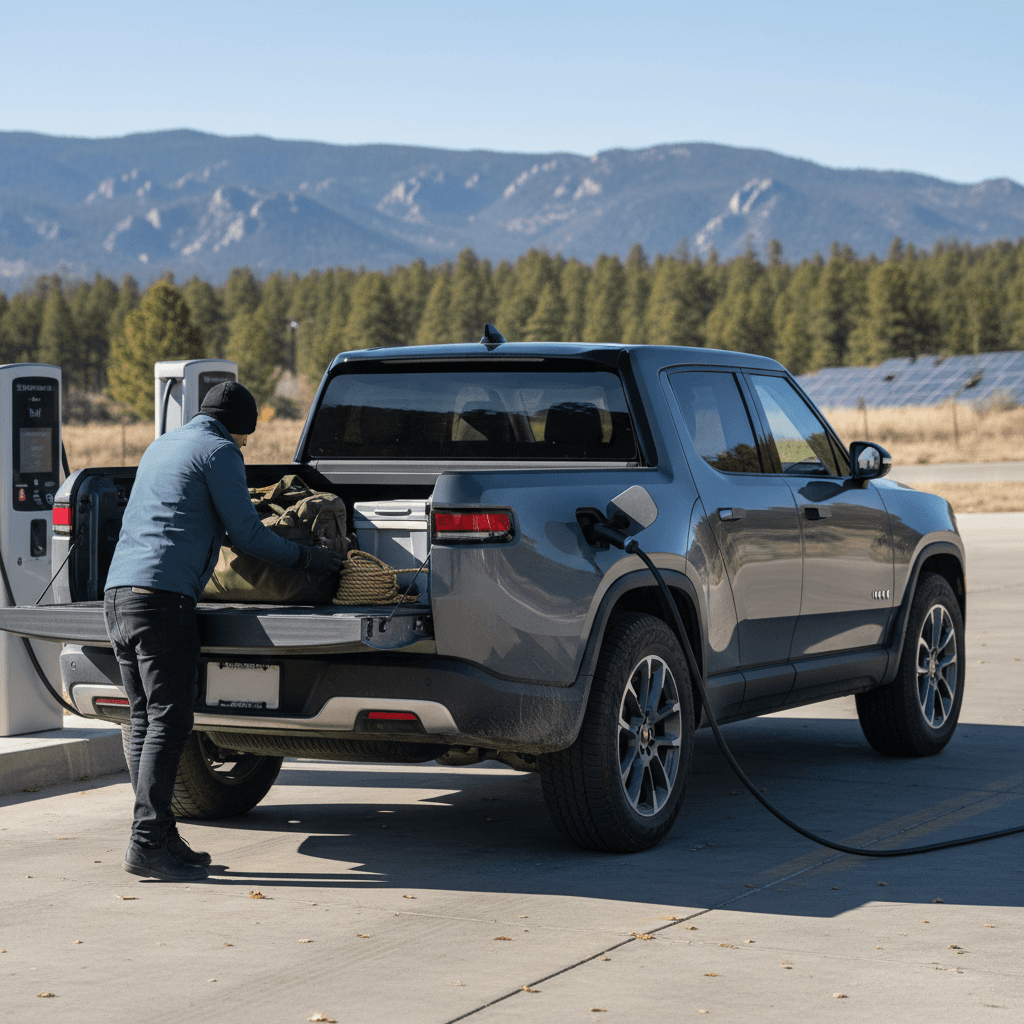
- DC fast charging: The R1T can take advantage of 200 kW+ chargers, but peak speeds depend on pack temperature and station quality.
- Home charging: On a 48‑amp Level 2 unit, you can typically add 25–30 miles of range per hour, easily refilling overnight.
- Networks: Rivian’s own Adventure Network, along with CCS/NACS public stations, dramatically expands long‑trip options compared with a few years ago.
Plan for charging like you’d plan for fuel stops
Towing, hauling, and everyday utility
If you’re looking at a 2024 R1T instead of a traditional half‑ton, you probably care as much about real‑world capability as you do about 0–60 times. The good news: properly equipped, the R1T is rated to tow up to 11,000 pounds on certain dual‑motor Max Pack configurations, with payload in line with many light‑duty trucks. The catch is that towing and range are joined at the hip.
- Expect range to drop by 40–60% when towing a tall, heavy trailer at highway speeds.
- A weight‑distributing hitch is required to unlock the highest tow ratings; without it, ratings are much lower.
- The shorter 4.5‑foot bed is fine for bikes, tools, and camping gear but less ideal for long lumber without a rack system.
- The Gear Tunnel and under‑bed storage make up for some bed length, especially for valuables and dirty gear.
Verify the tow package
Pricing, incentives, and total cost to own
New‑truck MSRP for a 2024 Rivian R1T varies widely with motors, battery pack, wheels, and options, but most builds ended up in the upper‑$70,000s to low‑$90,000s when new. In today’s used market, many 2024s are trading from the low‑$50,000s to around $70,000 depending on mileage and spec.
Typical 2024 R1T cost picture
Approximate U.S. pricing bands as of early 2026. Always check live listings in your area.
| Configuration | Mileage band | Typical asking price | Notes |
|---|---|---|---|
| Dual‑Motor, Standard/Large Pack | 10k–25k miles | $50,000–$60,000 | Often the value play; verify pack size and wheel/tire setup. |
| Performance Dual‑Motor, Large/Max Pack | 10k–25k miles | $58,000–$70,000 | Carries a premium for acceleration and range; more desirable spec long‑term. |
| Quad‑Motor (earlier builds delivering into 2024) | Low mileage | $65,000+ | Niche but sought‑after; expect higher insurance and tire costs. |
Electric‑truck pricing moves quickly with incentives and demand, so treat this as a directional guide, not a quote.
Factor in charging, not just purchase price
New vs used 2024 R1T: how values are shaping up
The 2024 R1T has already taken its initial depreciation hit, which makes lightly used trucks especially compelling. Pricing data from guides and real‑world listings suggests that year‑one depreciation has been milder than many feared, helped by limited supply and strong demand for well‑optioned examples.
When a new 2024 (or leftover) makes sense
- You want to configure the exact color, interior, and wheels you prefer.
- You plan to keep the truck 6–10 years and want maximum warranty runway.
- There are factory or dealer incentives that narrow the gap to used pricing.
When a used 2024 is the smarter play
- Someone else already ate the steepest early depreciation.
- You can find a low‑mileage Performance Dual‑Motor or Max Pack for thousands less than MSRP.
- You’re open to a broader color/option mix if the numbers make sense.
How Recharged approaches used R1Ts
Ready to find your next EV?
Browse VehiclesReliability, battery health, and warranty coverage
No honest R1T buying guide should pretend the truck has the same long‑proven track record as a decade‑old full‑size from Detroit or Japan. Owner reports paint a mixed picture: many 2022–2024 trucks run tens of thousands of miles with only minor issues, while others see more frequent trips to service for software bugs, trim rattles, 12‑volt battery replacements, or occasional hardware failures.
- Early‑life glitches are common with any first‑generation EV; what matters is how quickly they’re resolved and whether they recur.
- Rivian’s remote diagnostics and mobile service can be a major plus if you live far from a service center.
- Battery packs themselves have held up well so far, with many high‑mileage owners reporting little to no noticeable range loss in the first 40,000–70,000 miles.
- Consumer‑survey data has rated Rivian below average on reliability, but very high on owner satisfaction, people tend to love the truck even if they’ve had issues.
Know your warranty before you buy
Battery and charging health: what to look for
1. Compare displayed range to spec
At 100% charge, does the truck show a realistic range for its battery pack and wheels? A modest difference is normal; a huge gap might warrant deeper investigation.
2. Review charging history
Ask how often the owner fast‑charges versus home charging, how high they typically charge, and whether the truck has ever lived at 100% for long periods.
3. Look for charging‑system repairs
Scan service records for repeated DC‑fast‑charging issues or onboard‑charger replacements. One fix isn’t a deal‑breaker; a pattern can be.
4. Get third‑party battery data when possible
Tools like the Recharged Score use independent diagnostics to go beyond what the in‑car display shows, giving you a more objective read on pack health.
Inspection checklist for a 2024 R1T test drive
Whether you’re test‑driving a certified pre‑owned Rivian or a private‑party truck in the seller’s driveway, take a systematic approach. The R1T’s unique features, the powered tonneau cover, air suspension, and complex lighting, give you more to check than a basic pickup.
2024 R1T walk‑around and road‑test checklist
Exterior and body
Check for panel alignment at the hood, doors, and tailgate; inspect the glass roof, headlights, and tail lamps for cracks or moisture. Look under the truck for off‑road scrapes on skid plates or suspension arms.
Tires, wheels, and brakes
Note tread depth and even wear; big, sticky tires are expensive. On the test drive, feel for pulsation under braking and listen for grinding or squeaks.
Suspension and ride quality
Cycle between ride heights and drive over imperfect pavement. Listen for clunks or rattles that might suggest bushing or damper wear.
Interior electronics
Test every seat adjustment, window, mirror, door handle, and the powered tonneau if equipped. Spend time with the center screen, navigation, audio, phone integration, driver‑assist, and drive‑mode settings.
Driver‑assist features
Verify that adaptive cruise, lane‑keeping assist, parking sensors, and cameras work as expected. A road test on a light‑traffic highway stretch is ideal.
Charging demo
If possible, plug into a Level 2 charger during the visit. Confirm that the truck begins charging promptly and that no warning lights appear.
Should you buy or lease a 2024 R1T?
For a relatively young brand whose software and hardware are still evolving quickly, the buy vs. lease decision on a 2024 Rivian R1T is more than just a payment question. It also reflects your appetite for tech change and your guess about future resale values.
Arguments for buying
- You plan to keep the truck at least 5–7 years.
- You want to build equity and potentially benefit if resale values hold up well.
- You’re comfortable with the risk that newer Rivian models and competitors might move the goalposts on features and range.
Arguments for leasing
- You like driving the latest tech and want an easy exit when your term ends.
- You’d rather Rivian or the lessor carry most of the future‑value risk.
- You may benefit from tax treatment that favors leasing in your state or for your business.
Run the numbers both ways
How Recharged helps with a used R1T
Shopping for a used 2024 Rivian R1T can feel different from shopping for a used F‑150 or Tacoma. There are fewer trucks on the road, fewer independent shops that truly understand them, and more nuance around software history and battery health. That’s exactly the gap Recharged set out to fill.
- Recharged Score Report: Every vehicle on Recharged includes a report with verified battery diagnostics, pricing vs. the broader market, and a check of key equipment like the tow package.
- Expert EV support: You can talk with EV‑specialist advisors who understand R1T quirks, common fixes, and which options truly move the needle on value.
- Financing and trade‑in: Arrange EV‑friendly financing, get an instant offer on your current vehicle, or explore consignment if you’re selling an R1T yourself.
- Nationwide delivery and digital paperwork: Browse, buy, and arrange delivery from your couch; if you’re near Richmond, VA, you can also visit the Recharged Experience Center.
Turn data into confidence
2024 Rivian R1T buying guide: FAQ
Common questions about buying a 2024 Rivian R1T
Bottom line: is the 2024 R1T right for you?
The 2024 Rivian R1T isn’t a traditional pickup with an electric twist; it’s a clean‑sheet rethink of what a truck can be. If you want full‑throttle acceleration, genuine off‑road chops, and quiet electric commuting in one package, and you’re willing to live with younger‑brand quirks, it can be a spectacular choice.
Your best move as a buyer is to focus on three things: the right configuration (motor, pack, and tow hardware that fit your needs), verifiable battery and service history, and total cost of ownership rather than just the monthly payment. Do that, and a 2024 R1T can be more than just a cool truck; it can be a smart long‑term decision.
If you’re leaning toward a used R1T, browsing trucks with a Recharged Score Report, and talking with an EV‑savvy specialist, can turn a complex decision into a confident one. From there, it’s just a matter of deciding which trail, boat ramp, or ski hill you want your first R1T adventure to start from.