If you’re eyeing a 2023 Porsche Taycan, you’re probably attracted to its performance and design, but you’ve also heard whispers about 2023 Porsche Taycan problems and fixes. The truth is somewhere in the middle: many owners have trouble‑free cars, but this is a complex luxury EV with more than its share of recalls and software quirks. The good news is that most common issues are well understood now, and with the right checks and fixes, a 2023 Taycan can be a fantastic used EV.
Quick take
2023 Taycan reliability in a nutshell
2023 Taycan reliability snapshot
The reliability picture for the 2023 Taycan is mixed. On one hand, owner satisfaction scores are strong and many cars rack up tens of thousands of miles with little more than software updates and routine maintenance. On the other, the 2023 model year has seen a high number of recalls and a steady stream of owner complaints about infotainment, charging behavior, and warning lights. When you’re shopping used, the question isn’t “Is the Taycan unreliable?” so much as, “Has this specific car had its issues sorted?”
Luxury EV rule of thumb
The biggest 2023 Taycan problem areas
Most common 2023 Taycan trouble spots
These are the patterns you see repeatedly in owner reports and repair bulletins.
Electronics & infotainment
Frozen or rebooting screens, camera glitches, and buggy over‑the‑air updates are among the most common complaints.
Charging & HV battery
Intermittent AC/DC charging failures, "Charging Error" messages, and software fixes for the high‑voltage battery control unit.
12‑volt battery & no‑start
Low 12‑volt state of charge can trigger warnings, block software updates, or even leave the car unable to start.
Warning lights & limp modes
Electrical or drive system warnings that may require a dealer visit and software update or module replacement.
Recalls & campaign work
Multiple recalls for camera, airbag, and electrical issues mean you must confirm completed campaigns on any 2023 Taycan.
Build & hardware niggles
Door handles, window regulators, and minor trim issues can crop up, annoying more than catastrophic, but they require shop time.
Crucially, most of these problem areas don’t point to a fundamentally bad car; they point to a cutting‑edge EV platform that has evolved quickly through software and hardware campaigns. That’s why a carefully vetted 2023 Taycan, ideally with thorough service history and completed recalls, can be a far safer bet than an early, un‑updated car.
Infotainment, cameras and electronics: problems and fixes
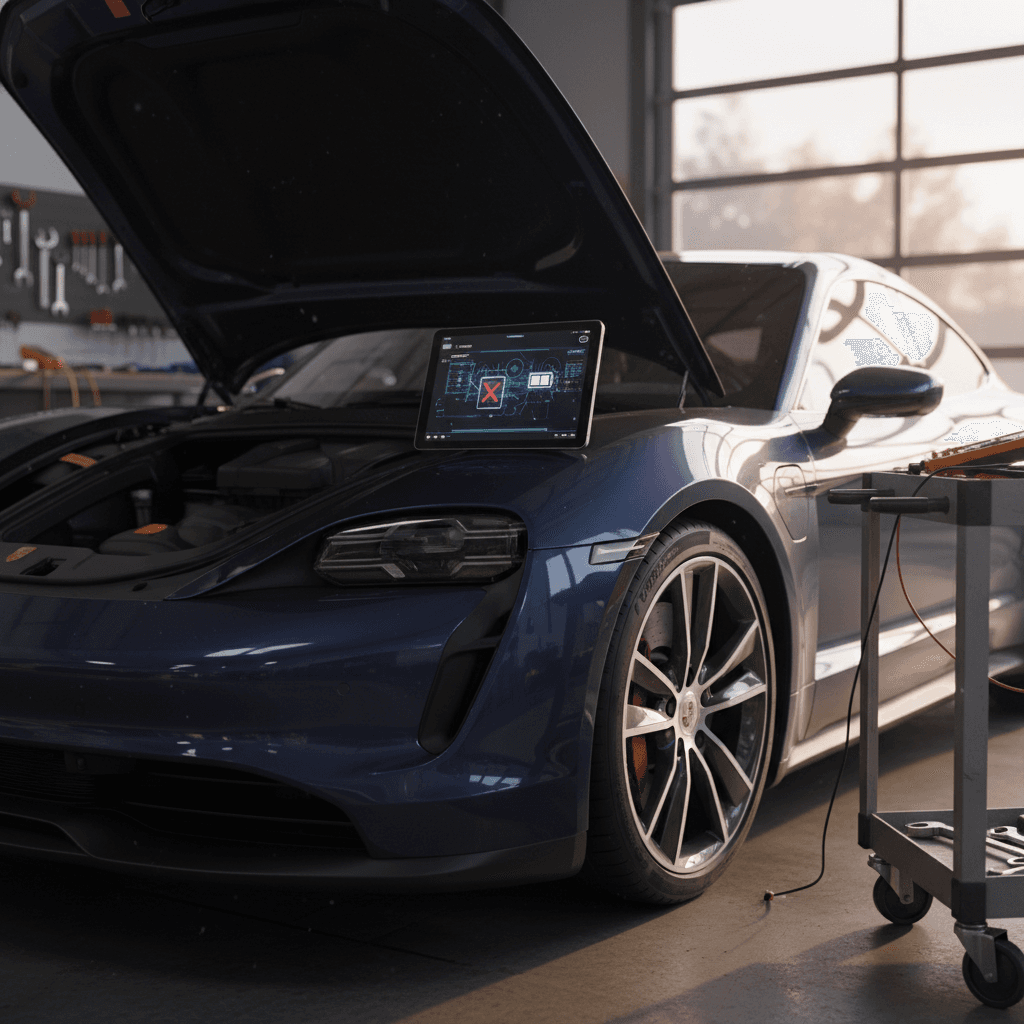
The Taycan leans heavily on touchscreens and software. When everything works, it feels futuristic. When it doesn’t, it can make the whole car feel broken even if the driveline is fine. Common 2023 complaints include frozen center screens, random reboots, slow CarPlay connections, and reversing cameras that sometimes fail to display when you select reverse.
- Center and upper screens freezing or taking a long time to boot on cold starts.
- Infotainment reboots in the middle of navigation or Apple CarPlay sessions.
- Rear camera image not appearing or cutting out, sometimes linked to a recall‑covered software bug.
- Bluetooth pairing issues and Porsche Connect app not reliably updating charge status.
- Over‑the‑air updates failing or stalling, often tied to low 12‑volt battery charge.
Simple infotainment resets
How to tackle 2023 Taycan infotainment issues
1. Note conditions when the fault appears
Write down what was happening when the problem occurred, temperature, whether you were using CarPlay, reversing, or fast charging. This helps the dealer reproduce the issue.
2. Perform a controlled PCM reboot
With the car parked, hold the power/volume knob until the screen blanks and the system reboots. If the camera works normally afterward, it was likely a transient software hiccup.
3. Check for available software updates
In the PCM menu, look for pending updates. If you’re not comfortable installing them yourself, ask the dealer to update the car during your next visit.
4. Ask your dealer about TSBs and recalls
Porsche has issued technical bulletins and recalls for camera behavior and software instability. A dealer can check your VIN and apply the latest fixes at no charge.
5. Keep a photo/video log
When the issue happens, safely record a short video on your phone. Visual proof is invaluable when a problem is intermittent.
The upside
Charging and high‑voltage battery issues
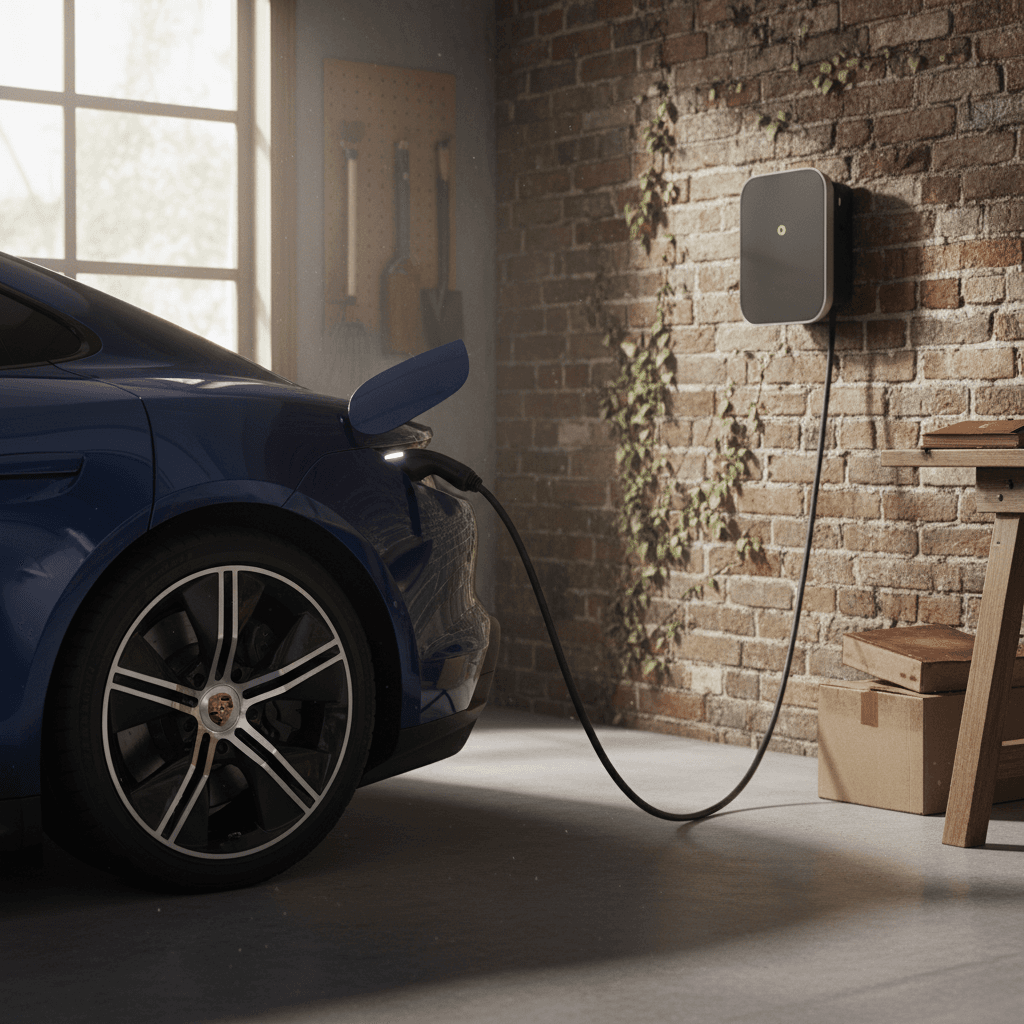
Battery and charging issues are the heart of most EV worries, and the Taycan is no exception. The 2023 model benefits from several years of running changes, but owners still report intermittent home charging failures, “Charging Error” messages at public stations, and, more rarely, high‑voltage battery faults that require dealer diagnosis.
- AC charging fails after a few minutes, then the car reports a charging error while other EVs charge fine on the same wallbox.
- DC fast charging stalls at low power or fails to initiate, sometimes resolved by moving to a different stall or network.
- State‑of‑charge and range estimates that seem jumpy or conservative until recent software updates are installed.
- Rare high‑voltage battery management faults that put the car into a reduced‑power or no‑start mode until repaired.
- On‑board charger issues, especially on higher‑power AC chargers, sometimes requiring hardware replacement under warranty.
Software is often the “fix”
Quick triage for 2023 Taycan charging problems
Use this to separate “likely environment or charger” problems from “likely car” problems before you panic.
| What you see | Likely cause | Owner steps | When to call the dealer |
|---|---|---|---|
| Car won’t charge on one home wallbox, but charges elsewhere | Home charger or wiring issue | Test a different charger; try a different circuit; check for ground faults | If other EVs charge fine but the Taycan fails repeatedly |
| Charging stops after a few minutes on multiple AC chargers | Software or on‑board charger issue | Reboot car, try again; test both AC and DC chargers | If it repeats across locations, schedule diagnosis |
| DC fast charging limited to very low kW on multiple networks | Battery temperature or software limits | Pre‑condition battery before DC charging; retry on warm battery | If speeds remain low in warm weather, ask for software/hardware check |
| Persistent high‑voltage warnings or no‑start after charging | Battery management or HV component fault | Do not attempt repeated restarts; arrange a tow | Immediately, this is warranty and safety territory |
If in doubt, err on the side of a dealer diagnosis, especially while the battery warranty is in effect.
Don’t ignore HV warnings
12‑volt battery trouble and no‑start situations
Like other modern EVs, the Taycan relies on a small 12‑volt battery to power control modules and wake the high‑voltage system. When that 12‑volt battery is weak, you may see low‑voltage warnings, aborted software updates, or, in the worst case, a car that won’t unlock or start, even if the main traction battery is full.
- “12V battery not charged enough” message when attempting a software update.
- Car refusing to go into Ready mode after sitting for several days.
- Intermittent warning lights that clear after driving, but return after the car sits.
- Complete no‑start/no‑unlock condition requiring a tow and 12‑volt service.
How to be kind to your Taycan’s 12‑volt battery
What to do if your 2023 Taycan shows 12‑volt issues
1. Plug the car in and let it sit
Connect to a reliable home charger and allow the car several hours to top off the 12‑volt battery from the high‑voltage pack. Avoid opening doors repeatedly while it “wakes up.”
2. Retry software updates after charging
If an update failed due to low 12‑volt charge, wait until the car has been plugged in for a while, then trigger the update again per the on‑screen instructions.
3. Avoid jump‑start improvisations
The Taycan has specific procedures and access points. Never clamp directly onto random terminals. If you’re not 100% sure, call roadside assistance.
4. Get a dealer to check for campaigns
Porsche has issued technical guidance and campaigns related to 12‑volt behavior. A dealer can update control units and, if needed, replace a weak 12‑volt battery.
Brakes, suspension and drive unit concerns
Mechanical failures are less common than software and electrical complaints on the 2023 Taycan, but they do exist. Owners occasionally report brake system warnings, air‑suspension faults on higher‑trim cars, and rare gearbox or drive unit problems, especially on higher‑mileage, hard‑driven examples.
- Brake system error messages that may require updated software or replacement of sensors or modules.
- Noises from the dual‑speed rear gearbox, or in rare cases, failure requiring replacement under warranty.
- Air‑suspension warnings or ride‑height issues on cars so equipped.
- Premature wear of consumables like tires and pads due to the Taycan’s weight and performance.
Why extended coverage matters
Key 2023 Porsche Taycan recalls to check
By April 2026, the 2023 Taycan had accumulated double‑digit NHTSA recalls, ranging from camera behavior to electrical and airbag concerns. Any individual car might have only a handful of these open, but you can’t assume recall work is complete just because it was sold or serviced recently.
Typical recall themes affecting 2023 Taycan models
Exact campaign numbers vary by trim and build date, so always run the VIN through a dealer or NHTSA before you buy.
| Recall theme | What’s affected | Risk if ignored | What the fix looks like |
|---|---|---|---|
| Rearview camera software | PCM software controlling the reversing camera | No or intermittent rear camera image; backing‑up visibility reduced | Dealer installs updated software; usually a short visit |
| Electrical system control units | Various modules managing power distribution and charging | Unexpected warnings, potential stalling or no‑start in rare cases | Software re‑flash or module replacement under warranty |
| Airbag and restraint logic | Sensors and control units for airbags and seatbelts | Airbags may not deploy optimally in specific crash scenarios | Dealer applies updated calibration/software, sometimes replaces components |
| High‑voltage battery control | Battery management control unit | Charging irregularities, HV warnings, very rare risk of thermal events | Control‑unit software update; in extreme cases, component replacement |
You want a car with all applicable campaigns marked “completed” in its service history.
How to verify 2023 Taycan recall and campaign status
1. Run the VIN through official tools
Enter the VIN on NHTSA’s recall lookup and ask a Porsche dealer to print a campaign/recall summary. Both should show "no open recalls" for a fully updated car.
2. Ask for service invoices
Look for line items mentioning recall codes or software campaigns for camera, battery control, or electrical modules. A thick stack of paperwork is good news here.
3. Confirm OTA updates have been applied
Some campaigns rely on over‑the‑air updates. If the prior owner ignored update prompts, the car may still be on old software until a dealer intervenes.
4. Schedule recall work before purchase when possible
If you’re buying from a Porsche dealer, ask them to complete all open recalls before you sign. For private sales, factor open recall work into your purchase timing.
DIY vs. dealer: when to fix it yourself, and when not to
Reasonable owner fixes
- Infotainment resets and basic settings changes (e.g., clearing Bluetooth pairings, re‑adding your phone).
- Testing multiple chargers to see if an issue follows the car or stays with a specific station.
- Routine 12‑volt care like keeping the car plugged in when parked for long periods.
- Documenting issues with photos and videos before a dealer visit.
Think of these as diagnostic prep and basic care, not true repairs.
Jobs for a Porsche dealer or EV specialist
- High‑voltage battery faults, warning lights, or repeated charging failures.
- Airbag, camera or brake recalls and any safety‑system warnings.
- 12‑volt replacement or jump‑starting beyond the official procedure.
- Gearbox, drive unit, or suspension problems, especially if you hear new noises under load.
With a car this complex, guessing can be dangerous and expensive. Warranty and recall coverage is there to be used.
High‑voltage disclaimer
Buying a used 2023 Taycan: how to avoid a problem child
If you’re shopping a used 2023 Taycan, you’re in a good position: most early bugs have been identified, and many cars are still under factory warranty. The key is separating well‑maintained, updated cars from those that bounced from owner to owner with half‑finished software and recall work.
What smart Taycan shoppers focus on
You’re not just buying a car, you’re buying its history and battery health.
1. Service & recall history
Look for clear records of software campaigns, recall completion, and regular maintenance. Multiple visits for the same complaint with no resolution are a red flag.
2. Real battery health data
Ask for a recent battery health report, not just a full‑charge estimate. Tools like the Recharged Score use diagnostics to show remaining capacity and charging behavior.
3. Warranty & coverage
Confirm in‑service date and remaining bumper‑to‑bumper and battery warranty. If you’re close to the end, consider extended coverage that explicitly includes EV components.
4. Test drive behavior
During a long test drive, watch for warning lights, screen glitches, and how the car behaves during AC and, if possible, DC charging.
5. Pre‑purchase inspection
Have a Porsche dealer or independent EV specialist perform a pre‑purchase inspection that includes scanning for stored fault codes and checking for open campaigns.
6. Price vs. condition
A cheaper Taycan that needs software, recall work, and tires can quickly erase any savings. Pay more for a well‑sorted example, it’s often cheaper in the long run.
How Recharged can help
Ready to find your next EV?
Browse VehiclesUsed 2023 Taycan pre‑purchase checklist
Confirm all recalls and campaigns are complete
Use NHTSA and a Porsche dealer printout to verify there are no open safety recalls or software campaigns on the VIN.
Review a recent battery health report
Look for capacity that roughly matches age and mileage and for a history of normal charging behavior. Be cautious of unexplained rapid degradation.
Scan for stored fault codes
Have a dealer or specialist scan the car. Persistent or numerous historic codes in the HV or charging systems deserve closer scrutiny.
Drive the car in varied conditions
Include highway, stop‑and‑go, and a brief charging session. Watch and listen for any warnings, noises, or odd behavior.
Evaluate total cost of ownership
Factor in insurance, tires, potential extended warranty, and expected charging costs. A Taycan is a Porsche first and an EV second, running costs reflect that.
Get numbers in writing
If you’re using financing, get pre‑qualified so you know your budget. Recharged can help you compare options with no impact on your credit score.
FAQ: 2023 Porsche Taycan problems and ownership
Frequently asked questions about 2023 Taycan problems
Bottom line: Is a 2023 Taycan worth it?
If you want a quiet, drama‑free appliance, a 2023 Porsche Taycan probably isn’t the right EV. It’s quick, charismatic, and deeply rewarding to drive, but it brings the complexity of a cutting‑edge luxury platform, plus a history of software and electrical hiccups that require an engaged owner and a good dealer relationship.
On the other hand, if you go in with your eyes open, insist on complete recall and software history, and pair the car with real battery‑health diagnostics and warranty coverage, a sorted 2023 Taycan can be one of the most satisfying used EVs on the market. Tools like the Recharged Score Report, EV‑specialist support, and flexible financing and trade‑in options make it easier to find the right example instead of inheriting someone else’s unfinished project. That’s the key to enjoying everything the Taycan does well, without letting its quirks spoil the experience.