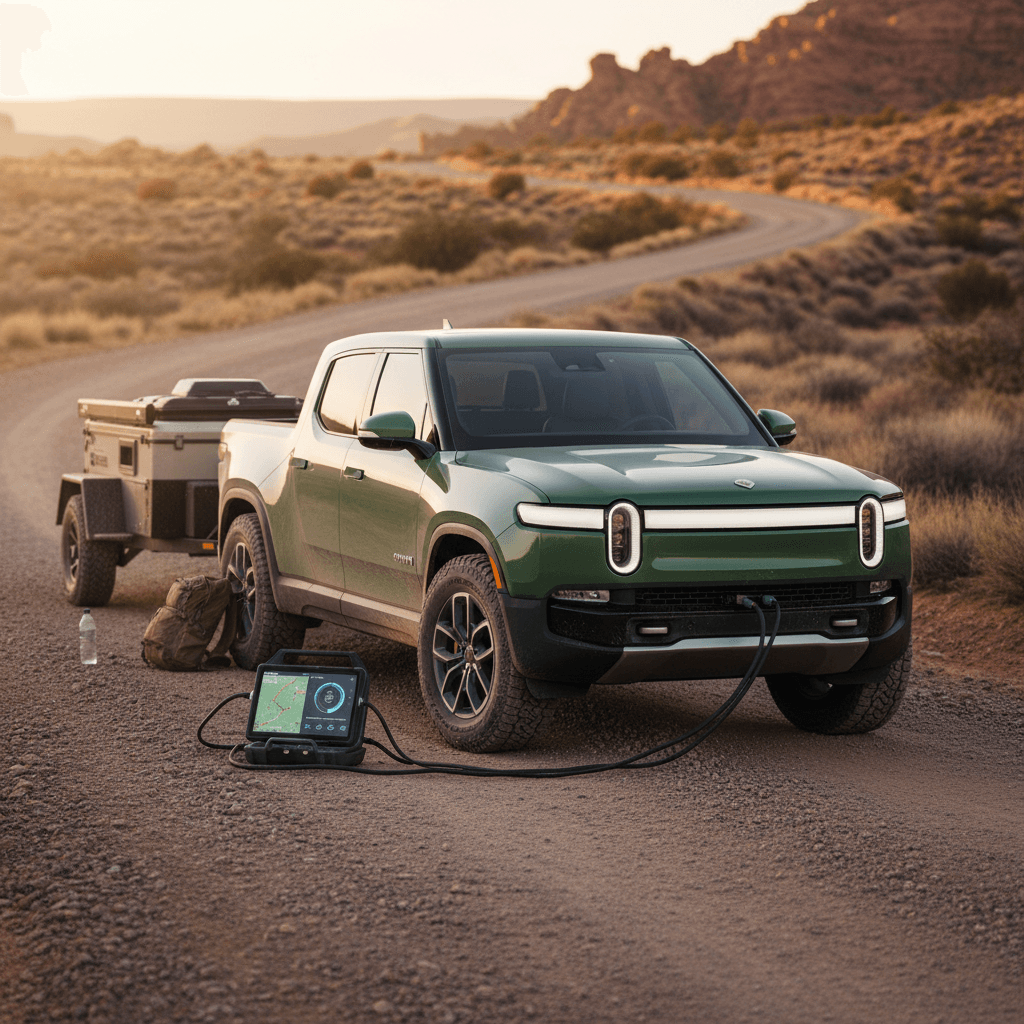
If you’re eyeing a 2022 Rivian R1T, you’ve already heard the headline: an EPA-rated 314 miles of range with the Large pack. But range tests tell a more interesting story. Once you add 70–75 mph highway speeds, all-terrain tires, cold weather, or a trailer to the mix, the 2022 Rivian R1T’s real-world range can swing by 100 miles or more. This guide pulls together the most trusted 2022 Rivian R1T range tests and translates them into what you can actually expect day to day, especially if you’re shopping used.
Quick Range Snapshot
EPA vs Real World: 2022 Rivian R1T Range Basics
Every 2022 Rivian R1T sold to U.S. customers used the 135 kWh “Large” battery pack and four-motor all-wheel drive. On 21‑inch road wheels, the truck carries an EPA combined rating of about 314 miles of range, with an EPA highway figure just under 293 miles. That’s your lab number. The moment you leave the brochure and head for the interstate, several things start nibbling away at that headline range: speed, wheel and tire choice, temperature, grade, and how much weight you’re hauling or towing.
2022 Rivian R1T Range by the Numbers
EPA Range Is a Best-Case Scenario
Highway Range Tests at 70–75 mph
Let’s start where most owners spend their time: the highway. Independent testers have logged multiple long, steady-speed runs in the 2022 Rivian R1T, usually at 70–75 mph. Those tests slice away the stop‑and‑go noise and show you how the truck behaves on a real road trip.
Real-World 2022 R1T Highway Range Tests
Representative highway range results at steady speeds, from multiple outlets and conditions.
| Test Type | Speed | Wheels/Tires | Approx. Temp | Resulting Range | Notes |
|---|---|---|---|---|---|
| Highway loop | 70 mph | 20" all‑terrain | Mild | ~290–300 mi | Careful driving, mostly flat terrain |
| Instrumented test | 75 mph | 20" all‑terrain | Mild | ~220 mi | Higher consumption at sustained 75 mph |
| Mixed highway | 70–75 mph | 22" street | Mild | ~270–280 mi | Lower rolling resistance helps range |
| Owner road trip | 70+ mph | Mixed | Cold | ~220–240 mi | Cabin heat and cold pack reduce efficiency |
Actual numbers vary with temperature, grade, and wind, but these tests give a solid baseline for planning.
Two things jump out from these tests. First, the R1T can legitimately flirt with its EPA highway range if you stick to around 70 mph, run efficient tires, and have mild weather. Second, inch the speedometer up to a real‑world 75 mph, add knobby all‑terrain rubber, and your comfortable planning number drops closer to 220–250 miles on a full charge.
Realistic Road Trip Planning Number
How Wheels and Tires Change Your Range
Rivian offers three primary wheel/tire setups for 2022 R1T trucks: 20‑inch all‑terrain, 21‑inch road, and 22‑inch sport. The EPA numbers and independent tests all agree on one thing, rubber matters a lot. Rolling resistance and aero drag from the tire tread show up directly in your watt‑hours per mile.
2022 R1T Wheels & Tires: Range Tradeoffs
Same truck, same battery, very different range personalities.
20" All‑Terrain
Pros: Best off‑road traction and winter bite.
Range hit: Rivian’s own guidance suggests roughly a 10–15% reduction versus 21" road wheels. That can mean 30–45 fewer miles on a full charge.
Best for: Owners who prioritize trails, snow, and gravel over maximum highway range.
21" Road
Pros: Highest EPA range and most efficient on pavement.
Range hit: Baseline, this is how you get closest to the 314‑mile rating on a 2022 R1T.
Best for: Daily commuting, long-distance highway use, and maximizing real-world range.
22" Sport
Pros: Sharper steering response and sporty stance.
Range hit: Typically a 5–10% drop vs. 21" road wheels. Think 15–30 miles less per charge.
Best for: Drivers who like the look and feel and are willing to sacrifice some range.
Don’t Forget Winter Tires
Towing Range Tests: What to Expect
The R1T is rated to tow up to 11,000 pounds, and it’s brilliant at the job from a power standpoint. Range, however, tells a more sobering story. In multiple towing range tests, camping trailers, car haulers, and utility trailers, the pattern is clear: expect roughly half your solo-truck range when you hitch something sizable to the back.
Sample 2022 R1T Towing Range Results
Real-world towing tests highlight how quickly range falls when you add speed, weight, and aero drag.
| Trailer Type | Approx. Weight | Speed | Conditions | Estimated Range | Notes |
|---|---|---|---|---|---|
| Teardrop camper | ~6,000 lb | 55–60 mph | Cold, rolling terrain | ~150–170 mi | Truck used ~1.25 mi/kWh with pack near full |
| Utility trailer | 3,000–4,000 lb | 65–70 mph | Mild | ~160–180 mi | Less aero drag than a full-height RV |
| Car hauler | 7,000+ lb | 60–65 mph | Mixed | ~130–150 mi | Heavier load, more hills and wind |
| Light trailer | Under 3,000 lb | 60 mph | Mild | ~180–200 mi | Small frontal area and careful driving help |
Use these as conservative planning numbers; bad weather or steep grades can reduce range further.
Plan Towing Days Carefully
Towing With a 2022 R1T: Range-Saving Checklist
1. Use Towing Mode
Always enable the dedicated towing mode so the truck properly manages cooling, suspension, and regeneration. You’ll get more consistent efficiency and better braking feel.
2. Keep Speeds Down
Aerodynamic drag is your enemy. Holding 60–65 mph instead of 70–75 mph can add 20–30 miles of towing range in a 2022 R1T.
3. Think Aero, Not Just Weight
A 4,000‑lb low utility trailer usually hurts range less than a 4,000‑lb tall box. The bigger the frontal area, the more your range shrinks.
4. Mind Charger Access
Many public fast chargers aren’t trailer‑friendly. Scout locations ahead of time and favor sites that let you pull through or easily drop the trailer.
5. Watch State of Charge Windows
Plan to arrive with 15–20% battery and leave chargers around 70–80% to minimize charging time while preserving a healthy buffer.
Off-Road and Adventure Driving: Impact on Range
The 2022 R1T was practically built for the Instagram version of your life: dirt roads, forest trails, and snow‑covered fire roads. Low‑speed off‑roading itself isn’t as brutal on range as you might expect because aero drag is low. What does eat into your usable miles is a mix of elevation gain, soft surfaces, and heavy use of high ride heights that hurt efficiency.
Trail Days
If you’re crawling rocky trails at 5–15 mph, the truck’s instant torque and smart traction control do the hard work. Consumption often rises, but you’re not covering big distances, so trip range isn’t usually the limiting factor. The real concern is making sure you have enough charge to get back out to civilization and a compatible charger.
Overlanding & Back Roads
String together 100–150 miles of gravel, washboard, and two‑lane roads and you’ll feel the drag. The suspension may sit higher, the tires are digging in, and you’re climbing in and out of canyons. In practice, many R1T owners see 15–25% higher consumption than on smooth pavement at the same speeds.
Bring a Bigger Buffer Off-Road
Long-Term Tests: Efficiency and “Vampire” Drain
One of the best windows into any EV’s real-world range comes from long‑term tests: months of commuting, road tripping, and letting the truck sit in the driveway. For the 2022 Rivian R1T, those year‑long tests paint a picture of a truck that’s both wildly capable and undeniably energy‑hungry.
What Long-Term Tests Reveal About the 2022 R1T
Range isn’t just about a single heroic road trip.
Higher-Than-Rated Consumption
In one long-term evaluation, the average energy use hovered in the mid‑50s kWh/100 miles, versus an EPA combined rating in the high 40s. Translate that into range and you get a truck that more often behaves like a 250‑mile EV than a 314‑mile one under mixed driving.
Vampire Drain Is Real
Testers also documented more overnight battery loss than expected when the truck sat parked for several days. Software updates have improved this over time, but if you leave a 2022 R1T unused for a week or more, expect to lose a noticeable chunk of charge unless you enable deep sleep or keep it plugged in.
Simple Fix: Treat It Like a Smartphone
Cold-Weather Range: What Owners Report
Cold weather has a way of humbling even the biggest battery. The 2022 R1T is no exception. In freezing temperatures, real‑world tests and owner reports routinely show 20–30% less usable range on similar routes compared with mild‑weather drives. Short trips in particular can be brutal, because the truck has to warm up a very large battery and a very large cabin.
- At 20–30°F, highway range that’s 260–280 miles in spring might fall to 200–230 miles.
- Cabin preconditioning and seat heaters help comfort, but they still draw energy from the pack.
- All‑terrain or winter tires magnify cold‑weather losses by adding rolling resistance.
- Repeated short drives in the cold can temporarily make your truck feel like a 180‑mile EV until temperatures climb again.
Cold-Weather Range Playbook
Maximizing Range in a 2022 R1T
You don’t buy a 2022 Rivian R1T because you’re obsessed with eking out every last watt‑hour. You buy it because it can do more things, in more places, than almost any other EV on sale. But if you want to stretch its legs, a few thoughtful choices make a big difference.
Six Ways to Stretch Your 2022 R1T’s Range
1. Choose the Right Tires
If range is a priority and you don’t live off-road, consider 21" road wheels or a more efficiency‑focused tire. Aggressive all‑terrains look the part but can cost you 30–50 miles of range.
2. Tame Your Highway Speeds
Every EV pays a penalty above 70 mph. Set cruise control to 65–70 mph instead of 75–80 mph and you’ll immediately notice more comfortable range estimates.
3. Use Drive Modes Wisely
Stick to more efficient drive modes for daily commuting and save Sport or high off‑road settings for when you really need them. Height and dampers affect aero and rolling resistance.
4. Precondition Before You Unplug
In cold or very hot weather, let the truck precondition the cabin and battery while still plugged in. That way, your first 15–20 miles aren’t spent just getting everything up to temperature.
5. Plan Charger Stops Around 10–80%
DC fast chargers slow down as you approach 100%. On trips, it’s more efficient to charge more often but for shorter bursts between about 10% and 80% state of charge.
6. Watch the Energy Screen, Not Just Miles
The R1T’s built‑in energy tools will show your recent efficiency and projected consumption. Use them to adjust on the fly instead of fixating on the remaining‑miles number alone.
Used 2022 R1T: What Range Should You Expect?
If you’re shopping for a used 2022 Rivian R1T, you’re probably wondering how much real‑world range you’re giving up compared to a brand‑new truck. The good news: most early‑build R1Ts haven’t had enough time or mileage to suffer dramatic battery degradation. The bigger variables are how the truck is equipped and how it’s been used, towing, off‑roading, climate, and charge habits.
Reasonable Range Expectations
- Well‑maintained 2022 R1Ts on road‑biased tires often still deliver 250–280 miles on the highway in good conditions.
- Hard‑used trucks on chunky all‑terrain rubber in cold climates might feel more like 220–240‑mile vehicles day to day.
- Software updates can tweak range estimates over time, so always look at recent owner data and your own test drives.
Why Independent Battery Health Matters
When you’re buying used, you don’t just want to know the original EPA number, you want to know how this specific truck behaves. A detailed battery health report that measures capacity, fast‑charge history, and cell balance tells you whether the pack still has most of its original muscle, or if you should budget for less range than the window sticker promised.
How Recharged Helps With Used R1T Range
Ready to find your next EV?
Browse VehiclesFAQ: 2022 Rivian R1T Range
Frequently Asked Questions About 2022 R1T Range
Bottom Line: Range Takeaways for 2022 R1T Shoppers
The 2022 Rivian R1T is a rare kind of truck: it’ll hammer to 60 mph in sports‑car time, crawl a washed‑out trail to a trailhead you used to hike to, and still haul gravel on Sunday. The flip side is that it’s a heavy, high‑powered brick punching a hole through the air, so it won’t sip energy like a compact EV. In the real world, you should think of it as a roughly 250‑mile truck, with honest‑to‑goodness 300‑mile days possible if you play to its strengths, and 150‑mile towing days if you’re dragging a house behind you.
If you’re shopping a used 2022 R1T, focus less on the original EPA number and more on how this particular truck has lived, its wheels and tires, climate, towing history, and battery health. That’s exactly what the Recharged Score is built to surface. When you combine an independent battery report with what you’ve learned here about real‑world 2022 Rivian R1T range tests, you’ll know whether the truck in your driveway is ready for your daily grind, your weekend trail runs, and that big summer road trip you’ve been planning.